William Merritt Chase:
Disability, drinking, and narratives of dehumanization often come at an intersectional crossroads. In the 19th century, modern conceptions of evolution and addiction began to develop. In turn visual imagery of disability and disease became tools used to justify and accentuate one's lesser evolution, intellectualism, or civility. In this case study, I will discuss a historical reality of little people being depicted as “foolish drunkards” to create visual dichotomies that elevated other classes. More specifically, I will look at three paintings showing how a painting of a characterized Renaissance subject used modern conventions of drinking to perpetuate 19th-century understandings of addiction.
This article uses the terms little person/people and person/people of short stature. Other scholarship may use the term Dwarf (scientifically acceptable), or more derogatory terms, to refer to little people (the term currently preferred by those in the community).
As a young student, the American artist William Merritt Chase painted a scene that captured the american people. In 1875, Chase began working on a new subject at the Royal Academy of Munich. The theme of the Jester, or the “fool,” is a common subject in European Renaissance depictions in art. Chase painted two studies before landing on his final scene: “Jester Resting on a Chair” and “The King's Jester”. Chase submitted his final painting, “Keying up,” into the 1876 Philadelphia Centennial Exhibition and won a medal. The final work depicts the jester pouring a drink.
The beautiful thing about studies is the insight they give into the artist's intentions. We, as viewers, see what he alters, adjusts, and outright changes for the betterment of his narrative. In this article, I will analyze three paintings of the lone Jester. Each depicts the jester taking dramatically different actions and in various moods. I argue that his painting “Keying Up” uses costuming to create a caricature of the “fool”. Chase simultaneously uses modern conceptions of the “drunkard” to act with paired harsh realism, further dehumanizing the model.
“Keying up” by William Merritt Chase is described as a “bold Renaissance fantasy” in William Merritt Chase: A Modern Master.1 Though the jester caricature and garb may be right out of the Renaissance, William Merritt Chase was notorious for his love of German realism. He was deeply influenced by Wilhelm Leibl’s work in truly uncompromising, unidealizing portraiture and peasant life.2 Chase’s work often shows the brutal reality, and you can see him, as a young artist, searching for it in these studies. He was rebellious and hated historical paintings that were not depicted with absolute reality. Notoriously, in his Columbus work (also made in 1876),3 Chase changed the required composition to what he felt was a more accurate historical depiction. These studies of jesters are a window into William Merritt Chase wrestling with his creation of stereotyping and generalizing costume scenes, while his love of depicting the realities of the world seeps into his narrative.
In each of Chase's paintings, the jester performs a different action. None of which captures him actively performing to the king, nor the viewer. He is removed from a space of performance. Chase, therefore, gives the viewer a glimpse into the jester's “real self”. What William Merritt Chase struggles to understand is that reality is not found in a costume.
William Merritt Chase, Public domain, via Wikimedia Commons
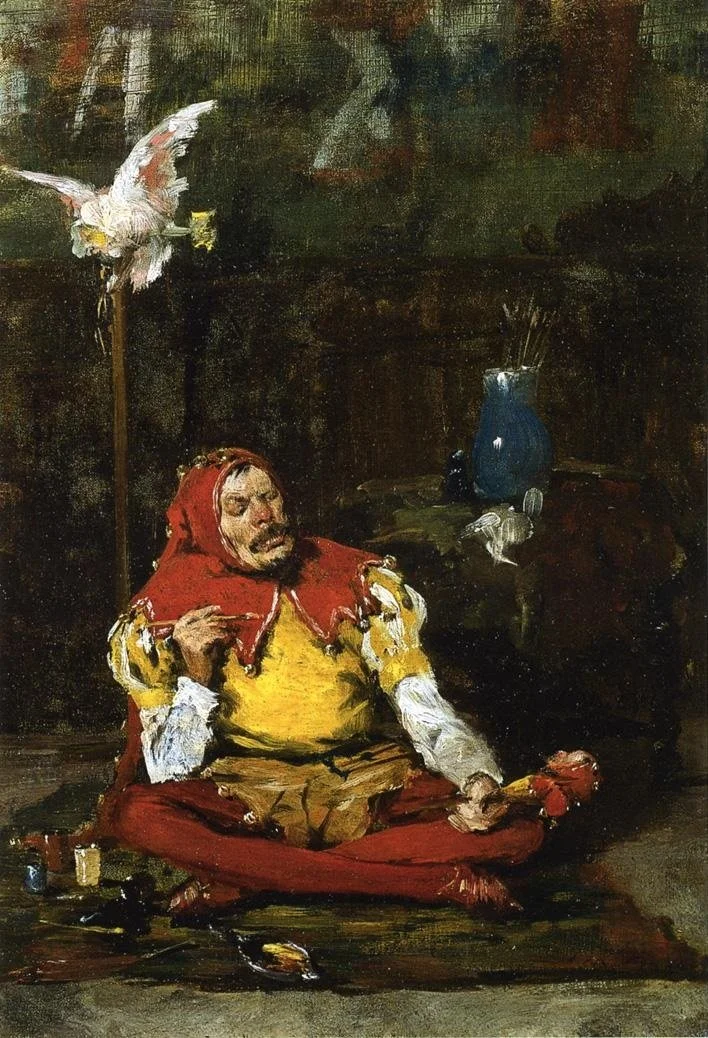
“The King’s Jester”
William Merritt Chase, 1875, Oil on Canvas, 18.5 in x 13 in, Private Collection
William Merritt Chase, Public domain, via Wikimedia Commons
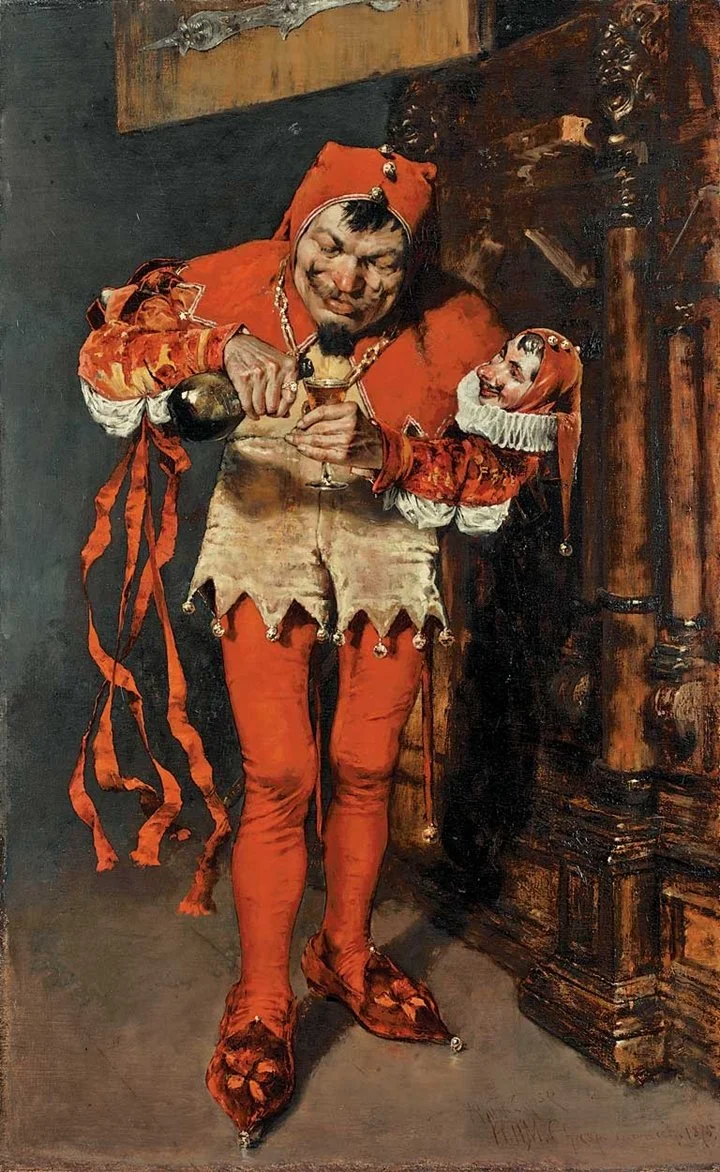
“Keying Up”
William Merritt Chase, 1875, Oil on Canvas, 39 ¾ in x 25 in.Pennsylvania Academy of Fine Arts
William Merritt Chase, Public domain, via Wikimedia Commons
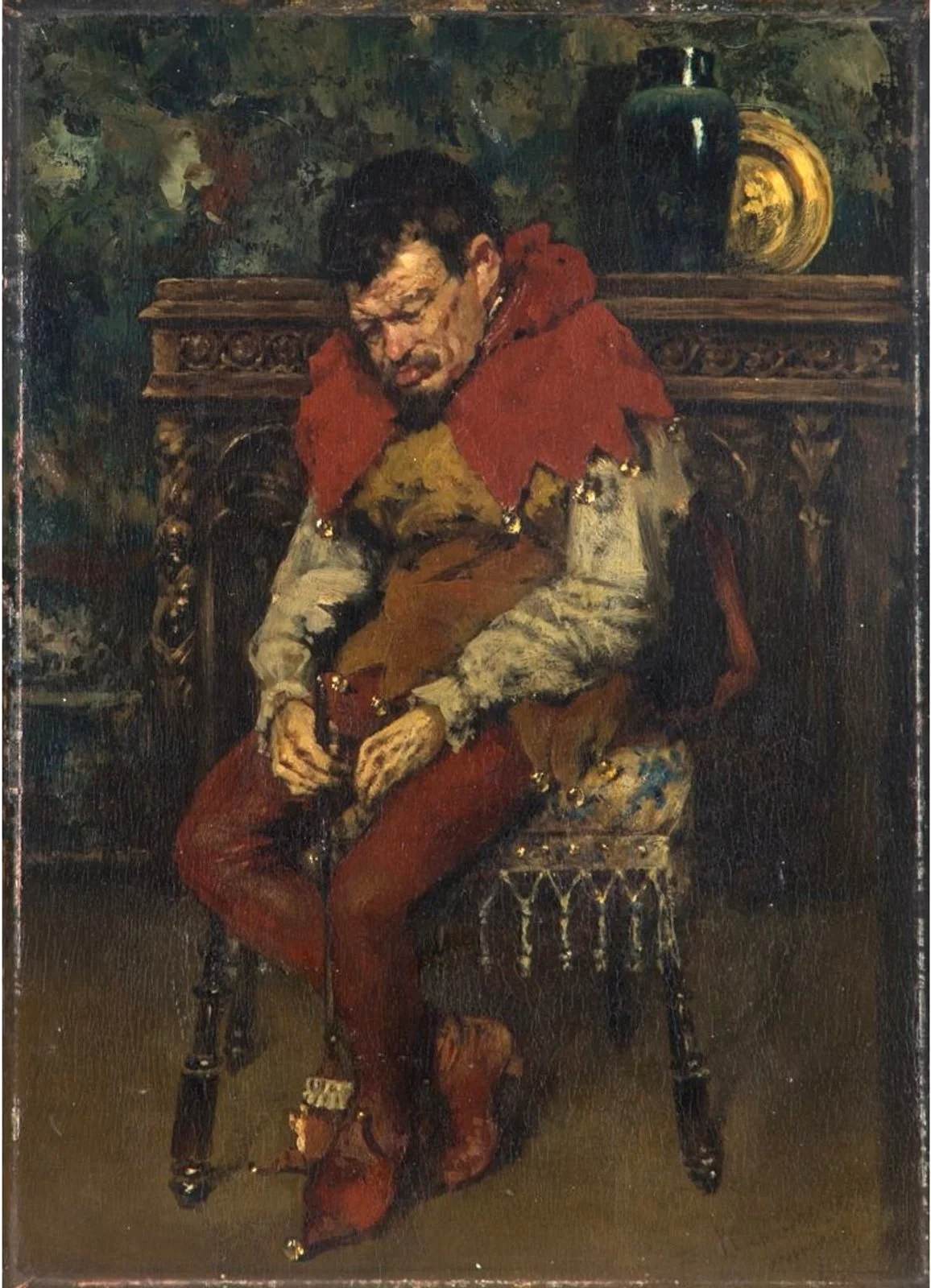
“Jester Resting on a Chair”
William Merritt Chase, 1875, Oil on Wood Panel, unknown dementions, Private Collection
Chase’s first study is likely “The King's Jester,” given the absence of focus on the figure's stature and his lack of total isolation. From the title, we see the King is still a subject. This gives the jester value and purpose. “The King's Jester” also has his bird watching over him. His cockatoo stands out dramatically, made of larger gestural strokes of white and yellow, pairing well with the bright colors of the jester's own garb. Behind this bird is a murky mural of people’s white and red pant legs seemingly dancing on the painted grass behind him. His figurative companions take up the entire top third of the picture plane. Though he is removed from society at the present moment, Chase makes his impact known. It is emphasized that he both has a purpose and companions. Chase has not brought out the harsh realities of the jesters’ life, just the tasteful “behind the scenes.”
The bottom two-thirds of the picture plane are clearly sectioned away by dark wooden wainscotting. This dark background brings the viewer's focus to the brightly dressed jester while he performs another part of his artistry, painting his Harlequin. Though the viewer is not given access to view the jester’s work, his precision and focus are made known through his gaze. The jester is dressed in his Renaissance garb, cross-legged, paint and utensils strewn around him, with a bright blue vase holding more paint brushes behind him balanced on a barely rendered table. Chase's use of color brings your eyes to the different tools the jester uses to make his art. This portrait still actively highlights the skills of the jester as an artist. The subject is still the Jester as a performer.
As you look at what he paints, his harlequin, your attention is brought to his abnormally long legs, which the harlequin rests on. The viewers’ focus lingers on his particularly long femurs. Cross-legged is not an easy position to paint, but his legs are long for anyone, let alone if Chase's intended goal was to depict a little person at this point in his process.4 In this study, there is a clear lack of clarity in his stature, with elongated legs and unclearly rendered furniture. His other two works both clearly emphasize the figures' short stature through the use of musculature and furniture. This is another reason why I believe this was the first trial pose. It shows his emphasis, goal, and adjustment of the sitter's body to make the jester’s short stature known.
This study is particularly interesting as Chase renders the jester in the least representative way of a little person, yet it is the most humanizing image of the jester. As his studies progress, Chase makes the jesters’ short stature and loss of inhibitions more defined to the viewer. Chase, in turn, emphasizes the perceived connection between little people and dependence on alcohol.
William Merritt Chase, Public domain, via Wikimedia Commons
“The King’s Jester”
In this study, Chase depicts a fellow artist. Unlike a professional painter or artist, the subject sits on the ground, seemingly in a random room, sans a professional workshop. The jester still ceases to have personal ownership. He is still not named, but instead labeled as “The King’s…”. Though it still has its flaws, the comfort of this study emphasizes Chase’s decision in making the clear, darker realities in the final image so blatant. Chase sought after this German Realism. Well… as close as one could get to it in a Renaissance-themed painting of a costumed caricature. It feels as though it was not his goal to paint a “behind the scenes” of the artist's life as a jester for the king. As we progress through the studies to the final painting, there is a stark change of focus towards the subject's sadness and detachment.
William Merritt Chase, 1875, Oil on Canvas, 18.5 in x 13 in, Private Collection
In the painting “Jester Resting on a Chair,” he is distant and utterly sad. He limply holds a long stick with white ruffles at the end connecting to a brass head. I believe this is his harlequin. Its face is driven into the ground behind his feet, as his hands lie in his lap. Chase renders the jester's glum face and veiny hands in a way that is only attributed to a harshly lived life. His clothes are no longer bright yellow and white; instead, they are a muted mustard and patchy off-white. Chase makes it clear for the viewer to see the red dye worn out at the jesters’ knees. He is hunched over so that the wood table behind him, with elegant designs carved into it and long ornate legs, lines up with his receding hairline. This study is ambiguous in terms of when the performance happened. The other works portray the beginnings. This portrait seems more like the aftermath of a show that went poorly, the end of a long harsh career. A much-deserved rest for a glum artist. Not quite the message that the final work portrays.
William Merritt Chase, Public domain, via Wikimedia Commons
“Jester Resting on a Chair”
William Merritt Chase, 1875, Oil on Wood Panel, unknown dementions, Private Collection
In the final work, “Keying up,” the jester is a similarly depicted age as “Jester Resting on a Chair”. The title clearly contradicts the end of his career. If one did not know the title, they could see his beautiful, pristine garb, ready for an act fit for the king. This jester is adorned in gold jewelry. An additional necklace and ring that neither had before. The garb of the jester in this final work is a bright, silky red, with a velvety tan and gold trim. His attire displayed his accomplishment and station. This leads the viewer to question why a well-dressed, experienced (by the likes of his age), professional be anxious for a performance? Especially to a point where he would be so focused on having this drink to soothe his nerves? Or “Key” himself up?
The background gives this context . The jester’s bright red of his garb reflects in the warm tones of the wooden cabinet behind him. The viewer’s attention is brought to the open cabinet above him by the highlighted column of the cabinet. The door swung open, exposing the light wood and silver hinges. Making the viewer believe this open cabinet is where he got his alcohol from. The drink was not laid out for him on an accessible table, but something we see he had to scavenge and scrounge for. Chase clearly uses the cabinet, not only to highlight his search for alcohol but as a dual display of his short stature. The jester would have had to reach far above his head for anything he may have found in the open cabinet. The rest of the background is grey and a faded brown, bringing all of the visual focus is on this alcohol cabinet.
Chase not only depicts the cabinet open, showing his stature, but it also follows the angle of the jester's arm as he pours himself the drink he found within. Even if your eyes miss the cabinet, the unstable weaving of the bright red strands of fabric hanging off the jester’s poring arm creates a stark border around the subject, continually bringing your focus to the task he has at hand. Like “The King’s Jester,” he is utterly focused, but instead of painting, he is pouring himself a drink. We face the reality of a man desperate for a drink. The bottle is dark and cold in his hand, whereas the drink is a light warm brown, his glass nearly filled to the top. Pouring every drop out.
Chase makes the reality of the long-term effects of drinking visible in the face that is not “painted on”. The sad desperation of the jester compared to the painted joyous act of the Harlequin. He is still in costume; he still has to cater to the king, preparing himself to walk into a room of those who do not see him as human. Painted as such, memorialized as such. This drink he sought to hold and now pours is both what gets him ready to face the torture of being the embodiment of the “fool.” It is what he depends on to survive the life he leads. Yet it is simultaneously a thing that brings both the king's audience and 19th-century viewers to see him as such.
Chase is a man known for his realism and his portraiture. Depicting the character of the “Drunken Dwarf Jester” in a full-length portrait format, one where you see the loss of light in his eyes, grounds the caricature in reality. It is not some satirical print of gross gestural outlines. Instead, the viewer can practically feel the jester's blood running through his veins. Chase makes the jesters’ reality of dependence clear. Yet this is not a portrait. The sitter is not depicted as himself. This is the character of the “Drunken Dwarf,” the “fool”. A person who is dehumanized and belittled for the amusement of those in classes who view themselves as ranked above him.
William Merritt Chase, Public domain, via Wikimedia Commons
“Keying Up”
Chase makes the reality of the long-term effects of drinking visible in the face that is not “painted on”. The sad desperation of the jester compared to the painted joyous act of the Harlequin. He is still in costume; he still has to cater to the king, preparing himself to walk into a room of those who do not see him as human. Painted as such, memorialized as such. This drink he sought to hold and now pours is both what gets him ready to face the torture of being the embodiment of the “fool.” It is what he depends on to survive the life he leads. Yet it is simultaneously a thing that brings both the king's audience and 19th-century viewers to see him as such.
Chase is a man known for his realism and his portraiture. Depicting the character of the “Drunken Dwarf Jester” in a full-length portrait format, one where you see the loss of light in his eyes, grounds the caricature in reality. It is not some satirical print of gross gestural outlines. Instead, the viewer can practically feel the jester's blood running through his veins. Chase makes the jesters’ reality of dependence clear. Yet this is not a portrait. The sitter is not depicted as himself. This is the character of the “Drunken Dwarf,” the “fool”. A person who is dehumanized and belittled for the amusement of those in classes who view themselves as ranked above him.
William Merritt Chase, 1875, Oil on Canvas, 39 ¾ in x 25 in, Pennsylvania Academy of Fine Arts
More on the artist:
William Merritt Chase, like most people in the 19th century, was fascinated with theatricality and how to use costuming as a way of displaying a particular identity or stereotype. He may have been playing around with this format and style as a young artist, but he modernizes the subject to the viewer through the visually depicted dependence on alcohol, a much-discussed topic of this time in the States. The German realists that he adores at this time seep into his work, making his caricatures grounded in a dehumanizing reality. In the final image of the jester, “Keying Up”, William Merritt Chase no longer depicts the life of a jester outside of his space of performance. Instead, he paints a desperate fool’s search for alcohol. This series of jester paintings is quite unique in subject matter from his other work. During William Merritt Chase's time as a young artist, many of his portraits of young men included some element of inebriation.
This includes holding pitchers of alcohol and even smoking themselves.5 The jester is not a young boy; his wrinkles are accentuated. Chase clearly shows his age and the impact his habits have on his body. Chase’s portraits of women never display them with substances, but he does display them in costume. In these depictions of women, costuming plays a key role in showing a woman's prestige and power in their identity. Such as his depictions of “New Women”.6
Historically, the Jester is depicted as a little person who is heavily inebriated and made to be a “fool”.7 Throughout Europe and the U.S., little people have been (and are) mistreated, enslaved, exoticized, and displayed for the amusement of others. This display, and showmanship, of little people in comparison to those who are not of shorter stature is the main tool to create a dehumanized other (in this case, little people) in comparison to a created normal (non-shorter-statured people). A common way to exaggerate a “lack” of perceived normalcy is to make the other do things that are viewed as uncivilized. Drinking, specifically in excess, was not viewed as civilized, specifically in the U.S. in the 1870’s.8
The Jester's job is far more than just to perform for the king. The king is someone who must be above everyone else; they must be viewed as the picture of civility. European Royalty is not just human but a leader of human civility. As many of whom had suffered effects from inbreeding, giving them disabilities themselves, there was a need to create a performance of “perfection” or able-bodiedness.
A great way to heighten one person's visual performance of civility, power, and physical ability is to display the visual performance of another's incivility, perceived non-normativity, and depicted subhumanity. That is the job of the Jester or the “fool”. By the time Chase got to the scene, this job had been painted for centuries throughout European history. What surprises me is that, from what I have found, this was painted before his trip to Venice.9 Meaning he may not have seen Feast at the House of Levi, or other paintings of jesters, one may see during European travels, before painting these. There were many masterworks for him to study from in Munich. He was taught to study them extensively. 10,11
William Merritt Chase was a known lover of Velázquez. Velázquez, who did in fact paint numerous actual portraits of little people. One of which, “The court jester Don Antonio with a dog” (1650), similarly pictured a jester of the court. In the portrait, he is named, he is pictured as civil, orderly, and respectable with a dog beside him.12 It is not known if William Merritt Chase saw these paintings, but if he did, there is little resemblance in subject matter.
“Keying up” is not a portrait of a sitter, like much of Chase's work is. The sitter himself is unknown, his story rewritten. I suspect he would have lived in Munich in 1875. The only known story of the sitter we have is one shared by Katharine Roof:
“He used to tell a tale of the model for this study, who was fond of imbibing anything of an alcoholic nature that happened to be available. One day, while the painter was out of the room, the model consumed a considerable quantity of hair-tonic which Chase had put in a whiskey bottle, with the result that the next day the jester was not present at the studio.”
No further elaboration was made, the model is even referenced to as “the jester”.13 No name, as he too is in turn caricaturized into the stereotype of the “Drunken Jester”. Velázquez’s paintings of little people have the sitters named. Velázquez, like Chase, was known for depicting his master work style to portray modern narratives and understandings of the current times.
Erica Hirshler quotes Chase talking about his love and admiration for Velázquez in her studies of his depiction of the New Women.
“I saw in a new light the sublime example of Velásquez. What was so important for me was that Velasquez, with all his acquirement from the masters before him, felt the need of choosing new forms and arrangements, new schemes of color and methods of painting to fit the time and place he was called on to depict”
Chase’s painting, being a costume scene and not a portrait, is what dehumanizes the subject further. A caricature, painted in a full-length portrait style, in a room full of portraits and paintings of the modern new woman.14 This created a narrative that the subversion of truth is the reality. William Merritt Chase’s tale of the sitter further dehumanizes the subject, no matter whether the story is true or not. His lack of acknowledgment of the person who sits before him is dehumanizing. 15
Chase is painting a Renaissance narrative but he brings in modern conceptions of alcohol. In the final, he makes the narrative focus on the subject’s dependence on alcohol, rendered in a way that is truly pertinent to his modern society. He does not necessarily depict inebriation in the framework of Renaissance views of alcohol use.16 This makes the subject relatable to the viewer because it is a modern and controversial topic. It was also an image widely publicized throughout the U.S. Not only was the painting shown and prized, but this was “one of only a handful of etchings” by William Merritt Chase.17,18 He clearly was not an expert at the etching process, as the prints were inverted. He still made the effort to mass-produce this image and make it accessible to a wider audience. This was also a great way for him to show off back home to America that his studies abroad in Munich paid off. They were so popular that another artist later re-etched them so they would match the orientation of the painting.19
Depictions of little people depicted as drunken fools are not new, and they are still manufactured, and their dehumanizing narratives still spread. Little people should not be pictured this way. Their lives, their artistry, their personhood should be. William Merritt Chase created an image that perpetuates narratives that dehumanize little people and people with addictions. His work gives us a clear narrative of how little people, people with disabilities, and people with addictions were viewed in and around the 1870’s.
Notes :
Elsa M Smithgall et al., William Merritt Chase : A Modern Master : [Catalog of an Exhibition Held at the Phillips Collection, Washington, D.C., June 4-September 11, 2016 ; Museum of Fine Arts, Boston, October 9, 2016-January 16, 2017; Ca’ Pesaro-Galleria Internazionale d’Arte Moderna, Venice, February 11-May 28, 2017] (Washington, D.C.: The Phillips Collection; New Haven; London, 2016).
Ronald G Pisano, A Leading Spirit in American Art (Henry Art Gallery, 1983).
Elsa M Smithgall et al., William Merritt Chase : A Modern Master : [Catalog of an Exhibition Held at the Phillips Collection, Washington, D.C., June 4-September 11, 2016 ; Museum of Fine Arts, Boston, October 9, 2016-January 16, 2017; Ca’ Pesaro-Galleria Internazionale d’Arte Moderna, Venice, February 11-May 28, 2017] (Washington, D.C.: The Phillips Collection; New Haven; London, 2016).
“Little People/Dwarfism - Disability Belongs,” Disability BelongsTM, November 18, 2025, https://www.disabilitybelongs.org/inclusion-toolkits/little-people-dwarfism/.
Ronald G. Pisano, Russell T. Clement, “ William Merritt Chase: Portraits in Oil,” Library Journal, August 1, 2007. 9,12,14,15 and 16.
Elsa M Smithgall et al., William Merritt Chase : A Modern Master : [Catalog of an Exhibition Held at the Phillips Collection, Washington, D.C., June 4-September 11, 2016 ; Museum of Fine Arts, Boston, October 9, 2016-January 16, 2017; Ca’ Pesaro-Galleria Internazionale d’Arte Moderna, Venice, February 11-May 28, 2017] (Washington, D.C.: The Phillips Collection; New Haven; London, 2016). 12
Alison G Stewart and Paul Royster, Society and Style : Prints from the Sheldon Museum of Art (Nebraska: Zea Books, 2014). 22
Marzanna Jagiełło-Kołaczyk, “Dwarfs and Other Curiosities in the European Gardens,” 2009. 4.
Katharine Metcalf Roof, The Life and Art of William Merritt Chase (C. Scribner’s sons, 1917). 41
Ronald G Pisano, A Leading Spirit in American Art (Henry Art Gallery, 1983).
Ibid., 27.
Amy White, “Diego Velazquez’s Little People,” University of Kent Art History News, January 22, 2021, https://blogs.kent.ac.uk/artistry/2021/01/22/diego-velazquezs-little-people/.
Katharine Metcalf Roof, The Life and Art of William Merritt Chase (C. Scribner’s sons, 1917). 41
Elsa M Smithgall et al., William Merritt Chase : A Modern Master : [Catalog of an Exhibition Held at the Phillips Collection, Washington, D.C., June 4-September 11, 2016 ; Museum of Fine Arts, Boston, October 9, 2016-January 16, 2017; Ca’ Pesaro-Galleria Internazionale d’Arte Moderna, Venice, February 11-May 28, 2017] (Washington, D.C.: The Phillips Collection; New Haven; London, 2016). 22
Chase has a lot of interesting costume scenes such as ones where his wife models as a spanish woman and another where she is in Japonaiserie. This is not within this article's limits but could be looked into further.
Also not within the limist of this article.
Alison G Stewart and Paul Royster, Society and Style : Prints from the Sheldon Museum of Art (Nebraska: Zea Books, 2014). 22
Ronald G Pisano, A Leading Spirit in American Art (Henry Art Gallery, 1983).
Ronald G Pisano et al., William Merritt Chase : The Paintings in Pastel, Monotypes, Painted Tiles and Ceramic Plates, Watercolors, and Prints (New Haven, Conn. ; London: Yale University Press, 2006). 91
Bibliography
Bryant, Keith L. “Genteel Bohemian from Indiana: The Boyhood of William Merritt Chase.” Indiana Magazine of History 81, no. 1 (1985): 14–47. http://www.jstor.org/stable/27790854.
Burns, Sarah, and John Davis. American Art to 1900. Univ of California Press, 2009.
Clement, Russell T., and Ronald G. Pisano. “William Merritt Chase: Portraits in Oil: V.2: The Complete Catalogue of Known and Documented Work by William Merritt Chase (1849-1916).” Choice Reviews Online 45, no. 04 (December 1, 2007): 45–184345–1843. https://doi.org/10.5860/choice.45-1843.
Colombari, Lucia. “Lesson Learned: American Art at the Paris World’s Fair of 1867” MDCCC 1800 Vol. 6 (Luglio 2017). https://doi.org/10.14277/2280-8841/MDCCC-6-17-8.
Friedlaender, Gary E., and Linda K. Friedlaender. “Art in Science: Velázquez and Dwarfism—the Art of Observation.” Clinical Orthopaedics & Related Research 478, no. 1 (November 25, 2019): 31–33. https://doi.org/10.1097/corr.0000000000001076.
Gallati, Barbara Dayer. William Merritt Chase. EBSCOhost. National Museum of American Art, Smithsonian Institution, 1995.
———. William Merritt Chase : Modern American Landscapes, 1886-1890 . EBSCOhost. Brooklyn Museum of Art in association with H. Abram, 2000.
Glisson, James . “‘It’s in My Mind’: William Merritt Chase and the Imagination.” Panorama, 2017. https://journalpanorama.org/article/its-in-my-mind-william-merritt-chase-and-the-imagination/.
Jagiełło-Kołaczyk, Marzanna. “Dwarfs and Other Curiosities in the European Gardens,” 2009. https://dlibra.kdm.wcss.pl/Content/111801/25-26_03.pdf.
López, Victoriano Roncero, and Esther Cadahía. “The Court Jester in 16.” South Atlantic Review 72, no. 1 (2007): 93–110. https://doi.org/10.2307/27784682.
Martis, Susan, and Christine Fleming. “Invigorating the Muses in the Art Museum with the Performing Arts.” The Journal of Museum Education 44, no. 2 (2019): 168–77. https://doi.org/10.2307/48540107.
Merritt, William. “Gray’s Auctioneers.” Gray’s Auctioneers, April 17, 2018. https://www.graysauctioneers.com/blog-posts/2018/5/23/a-newly-discovered-work-by-william-merritt-chase-jester-resting-on-a-chair?srsltid=AfmBOoqsrRypF-qbUixn0zgPb6MBOQ7Gm2dDGwyhiYVlyetwfy1y6IyU.
Museum of Fine Arts, Boston. “Dress in the Paintings of William Merritt Chase.” YouTube, December 30, 2016. https://www.youtube.com/watch?v=vOX1jIXFs00.
———. “William Merritt Chase’s Modern Women.” YouTube, December 30, 2016. https://www.youtube.com/watch?v=I4wZpYERYug.
O’Bryan, Robin. “Able-Bodied and Disabled Dwarfs in Italian Renaissance Art and Culture1.” The Routledge Companion to Art and Disability, February 14, 2022, 168–87. https://doi.org/10.4324/9781003009986-13.
OjrzyñskaKatarzyna, and Maciej Wieczorek. Disability and Dissensus : Strategies of Disability Representation and Inclusion in Contemporary Culture. Leiden: Brill, 2020.
Pisano, David, and Ronald G Pisano. A Leading Spirit in American Art. Henry Art Gallery, 1983.
Pisano, Ronald G. The Complete Catalogue of Known and Documented Work by William Merritt Chase (1849-1916): Portraits in Oil. Yale University Press, 2006.
Clement, Russell T. “Pisano, Ronald G. William Merritt Chase: Portraits in Oil.” Library Journal, August 1, 2007. EBSCOhost.
Pisano, Ronald G, William Merritt Chase, D Frederick Baker, and Marjorie Shelley. William Merritt Chase : The Paintings in Pastel, Monotypes, Painted Tiles and Ceramic Plates, Watercolors, and Prints. New Haven, Conn. ; London: Yale University Press, 2006.
Robin O’Bryan. “Grotesque Bodies, Princely Delight”: Preternature: Critical and Historical Studies on the Preternatural 1, no. 2 (2012): 252. https://doi.org/10.5325/preternature.1.2.0252.
Roof, Katharine Metcalf. The Life and Art of William Merritt Chase. C. Scribner’s sons, 1917.
Se Won Hwang, Kun Hwang, and Sultan K Tukeshov. “Craniofacial Features of Dwarfism in the Paintings of Velázquez.” Journal of Craniofacial Surgery 34, no. 6 (May 22, 2023): 1804–6. https://doi.org/10.1097/scs.0000000000009368.
Smithgall, Elsa M, D Frederick Baker, Erica E Hirshler, Katherine M Bourguignon, Giovanna Ginex, John Davis, Terra Foundation, et al. William Merritt Chase : A Modern Master : [Catalog of an Exhibition Held at the Phillips Collection, Washington, D.C., June 4-September 11, 2016 ; Museum of Fine Arts, Boston, October 9, 2016-January 16, 2017 ; Ca’ Pesaro-Galleria Internazionale d’Arte Moderna, Venice, February 11-May 28, 2017]. Washington, D.C.: The Phillips Collection ; New Haven ; London, 2016.
Stewart, Alison G, and Paul Royster. Society and Style : Prints from the Sheldon Museum of Art. Nebraska: Zea Books, 2014.
Stewart, Alison G., and Paul Royster. “Society and Style: Prints from the Sheldon Museum of Art Society and Style: Prints from the Sheldon Museum of Art.” digitalcommons. Zea E-Books, January 9, 2014. https://digitalcommons.unl.edu/zeabook/22.
Touba Ghadessi. Portraits of Human Monsters in the Renaissance Dwarves, Hirsutes, and Castrati as Idealized Anatomical Anomalies. Medieval Institute Publications, 2018.
White, Amy. “Diego Velazquez’s Little People.” University of Kent Art History News, January 22, 2021. https://blogs.kent.ac.uk/artistry/2021/01/22/diego-velazquezs-little-people/.
Woods-Marsden, Joanna . A Vision of Dwarfs. ResearchGate, 2010. doi: https://doi.org/10.1163/ej.9789004179714.i-368.35.