Thomas Nast:
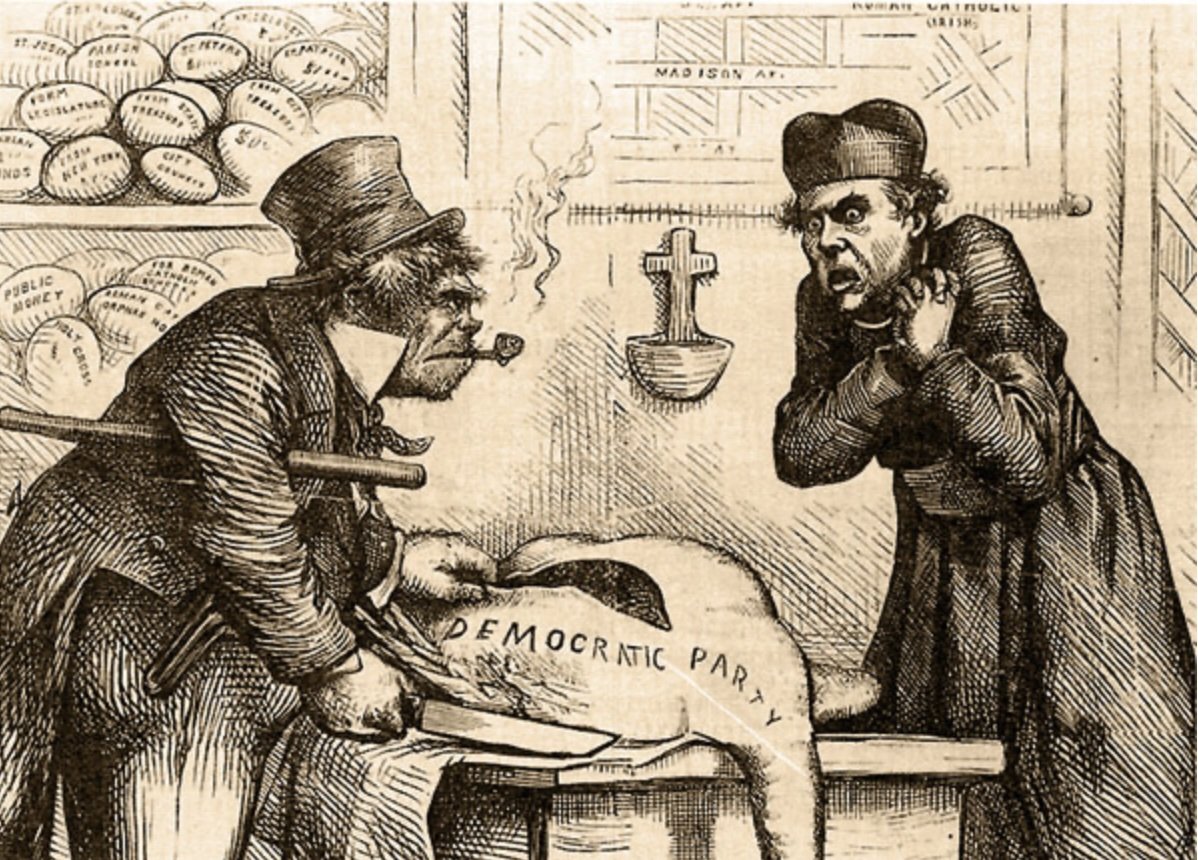
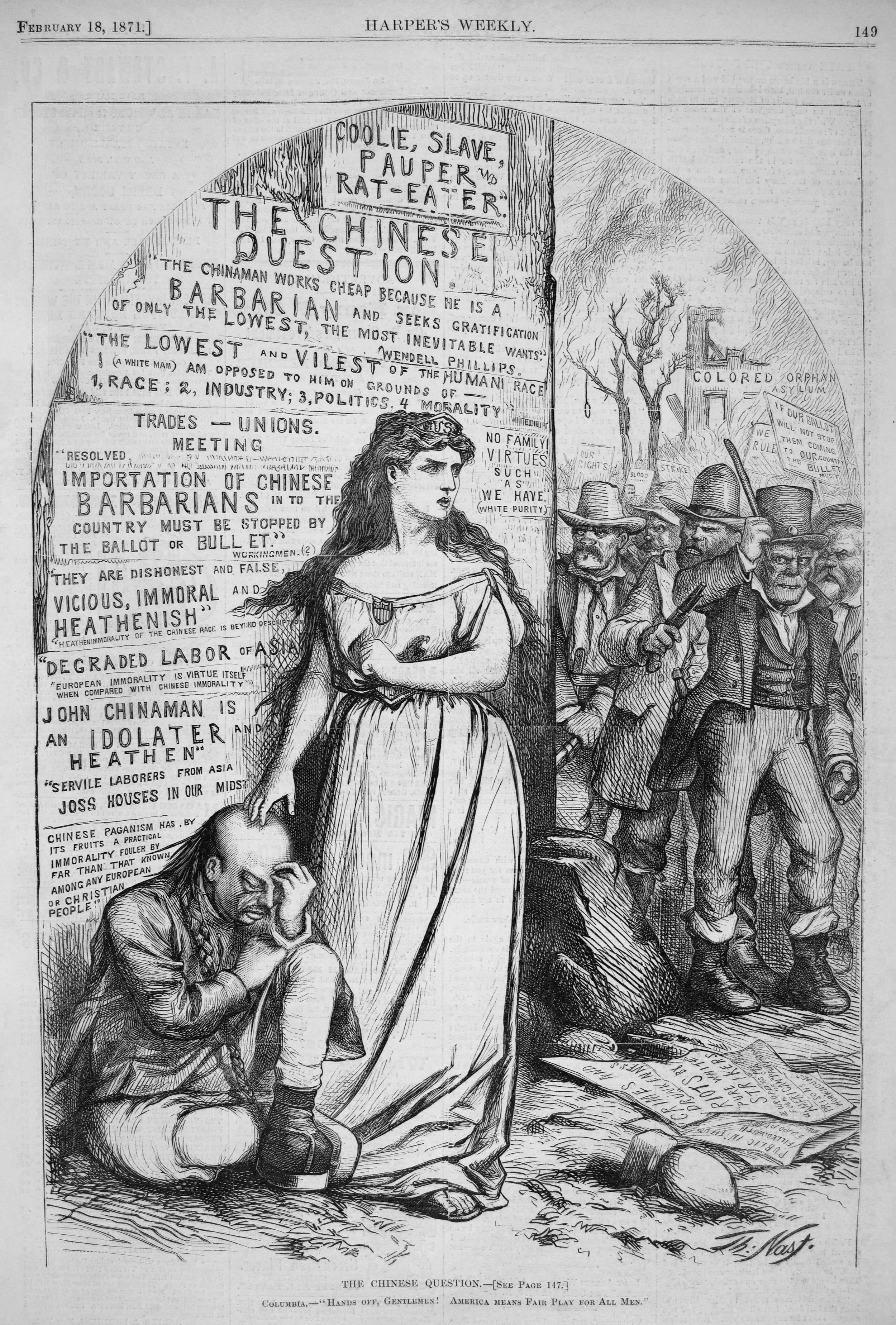
The United States and Immigrants have always had a volatile relationship. In this article, I will be talking about the depictions of the drunken, Simian, Irish immigrant that Thomas Nast depicted in his political cartoons during his time at Harper's Weekly in the U.S.
Political cartoons and satire are where you find some of the most racist imagery imaginable. Thomas Nast was an artist with volatile opinions who often used dehumanizing, simian, and intoxicated depictions to display the allowance of space in society for various Immigrant communities and races.
Backround information and further context:
There is a plethora of public information and research done on Thomas Nast by the group https://thomasnastcartoons.com/. Any and all research on his life, lineage, and artistry comes back to them. When it does not, it leads back to this publicly accessible website. https://storymaps.arcgis.com/stories/48f9751edb5d4c8ba9de962b3d695d7e
Each of these websites is incredibly thorough and detailed in their analysis and research. This article will respond to various statements and arguments made in these two works of great scholarship in reference to how Thomas Nast depicted the Inebriated Irish. His use of depictions of inebriation as a way to further dehumanize the Irish caricatures he depicted.
During the 19th century, immigration and the right to be of equal status to everyone else was the main debate. As it still is. Thomas Nast was a political cartoonist who, though with volatile and still harmful images produce, seemingly believed in everyone's equal status at the table. His truly abhorrent caricatures still harmfully categorized, generalized, and stereotyped many people. One may argue that he used methods of gruesome caricaturizing to comment and critique society on whether an outgroup should be in was a way of getting readers to question the “who is next argument.”
Thomas Nast's cartoon Which Color Is to Be Tabooed Next? depicts two men drinking and smoking at a table.
Nast notoriously used generalizing stereotypes. This article questions and analyzes his use of inebriation to create an order of validity and ownership over the right to occupy and be a part of the nation and society. This is done through looking at Thomas Nast's cartoons “The Usual Irish Way of Doing Things" and “Which Color Is to Be Tabooed Next?”
What is confusing, for many people, about Thomas Nast is his seemingly anti-colorism opinions. “Nast believed in tolerance of all races, nationalities, and creeds. He was not, however, tolerant of ignorance. He deplored the mob mentality which, in his mind, the Irish represented, instigated, and embodied.”1Perceived mental capacity (ignorance), savagery (mob mentality), and the inability to control one's indulgence (addiction) in alcohol were viewed as synonymous and proof of lower evolutionary status in the mid-late 19th century. With even Charles Darwin's “On the Races of Man” stating his beliefs on this.
“...and it appears that in every nation a new disease causes much death, until those who are most susceptible to its destructive influence are gradually weeded out;32 and so it may be with the evil effects from spirituous liquors, as well as with the unconquerably strong taste for them shown by so many savages.”2
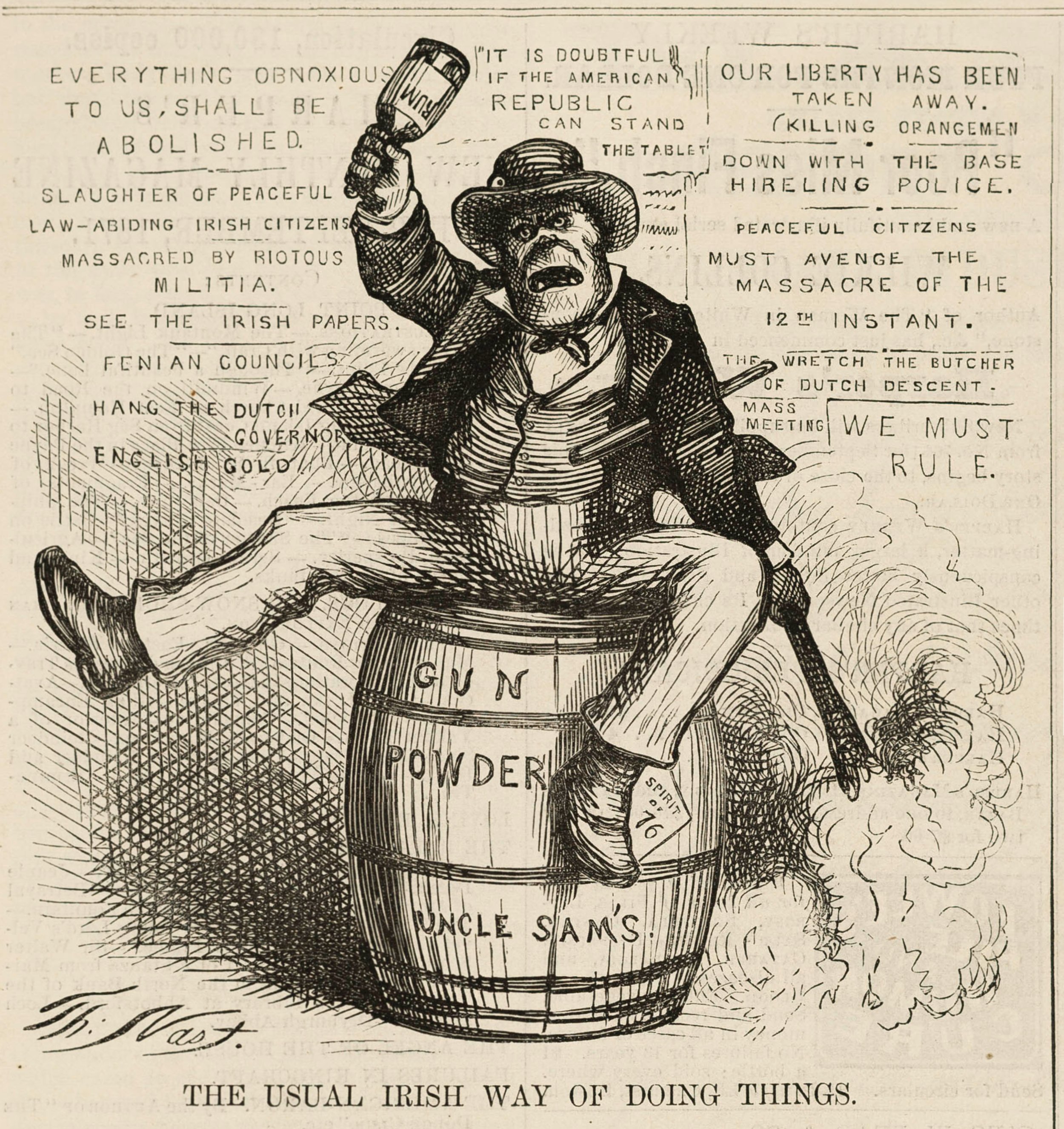
Thomas Nast, 1871, Wood Engraving
This quote, stated in February of 1871, by the leading scientist on race and evolution, argues that people who are seen as more affected and as having less control over liquor are more savage and predisposed to being weeded out evolutionarily.
It is not known if Thomas Nast read Charles Darwin's “On the Races of Man.” However, his depictions follow closely with Darwin's sentiments. There may not be a codified way to distinguish races visually, as physiognomics is far too varied within races. However, use of inhabitants and the effects of which were a possible differentiation between people and a way to display a visual hierarchy of savagery and civility, thus creates a deemed order of allowance for access into spaces of civilization.
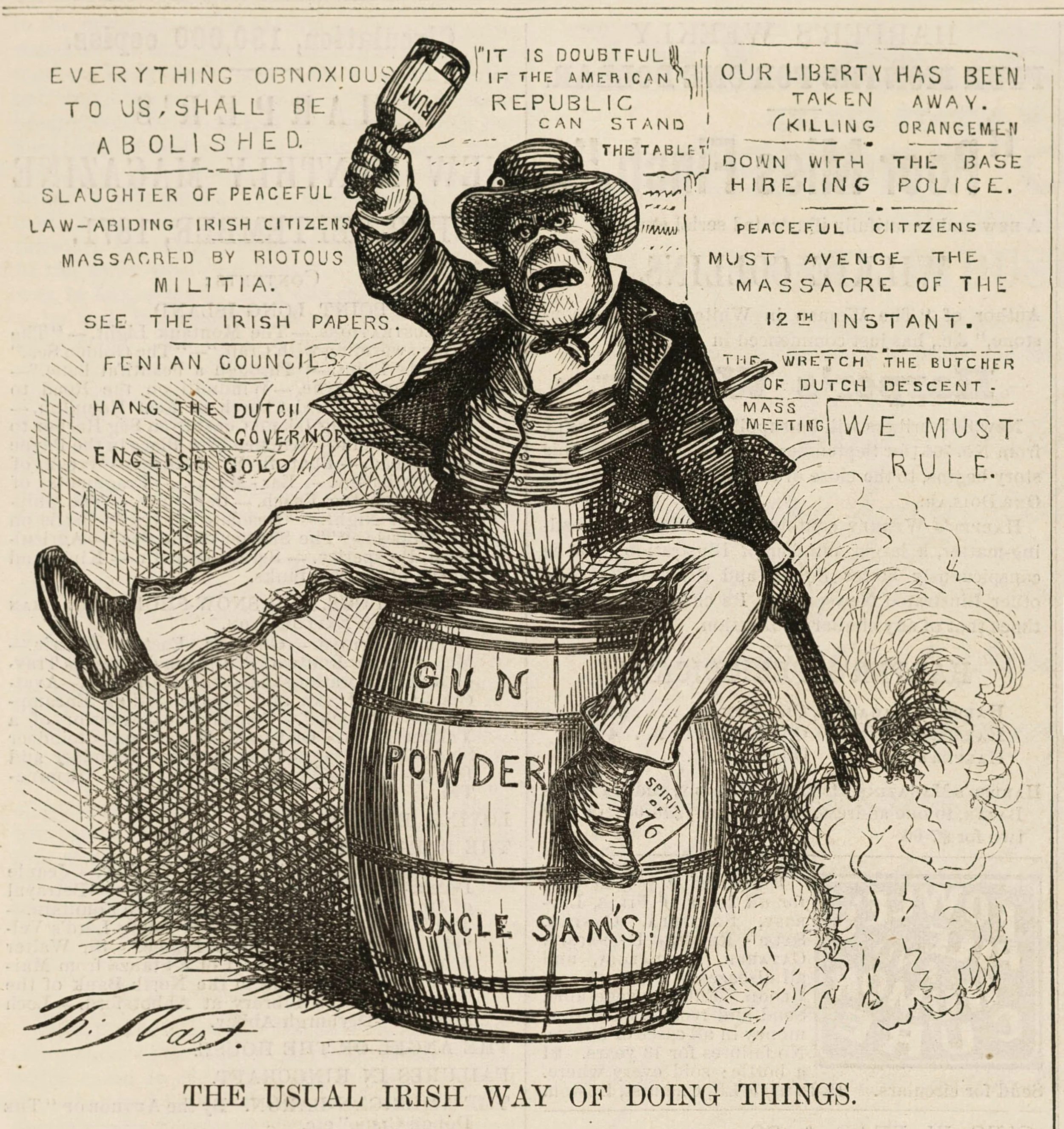
Thomas Nast had many of his far more simian in style caricatures of Irish people also published around 1871. One of which was "The Usual Irish Way of Doing Things," published in Harper's Weekly on 2 September 1871. This print depicts a simian Irishman with a large, gesturing movement of holding whisky. His movement is similar to that of a child throwing a temper tantrum, trying to get mothers attention. Flagging the viewer down with a bottle of rum. This is similar to another previous anti-Irish propaganda print by Fenaian Guy Fawkes. From 1867, but it has the additional alcohol element.
The Orangemen’s riots were happening at this same time (July 11-12, 1871), which would also argue for his increase in harsher visual caricaturizations.3 However, this article argues that Nast uses intoxicants as an additional display of visual typography for the viewer's understanding. The displayed need of intoxicants inherently decreases one's civility and therefore perceived right to a space by the viewer.
Thomas Nast, Public domain, via Wikimedia Commons

Thomas Nast, Public domain, via Wikimedia Commons
Thomas Nast, 1882, Wood Engraving
In “Which Color Is to Be Taboo Next?” Nast uses intoxicants to even the created racial hierarchy. Behind these two men seated in casual contemplation at a table, is Nast's iconic script saying “The NEW Declaration of Independence." “For twenty years no more Chinese laborers shall come to the United States;... and no court shall admit Citizenship”- a quote from the 1882 Chinese Exclusion Act. Nast purposefully placed “Independence” in quotes, forcing the viewer to question the authority of the nation and their own personal liberty within it. The men sit facing the viewer, their inebriants on display, drink on one hand, pipe in the other. One man, “Fritz,” a historically German name but has a generally French beret on, leans over to “Pat,” who follows a less simian depiction of an Irish man than normal for Nast, and asks "If the Yankee Congress can keep the yellow man out, what is to hinder them from calling us green and keeping us out too?"
A question asked between two immigrants, the question that all people in the position of “other” ask one another. In doing so, Nast questions the conception of races. Commenting on the simple naming of a created distinguishing factor, such as yellow or green. Nast is a German immigrant himself, so he would presumably know this question well. Fritz’s hand placed on Pat’s arm in a gesture of gentlemanly action. This print asks the question “Which Color is to be Tabood Next?” A question we still ask today.
Notes :
Illustrating Chinese Exclusion, “Early Influences on Thomas Nast,” February 15, 2014.
Charles Darwin, The Descent of Man, and Selection in Relation to Sex (London: John Murray, 1871), 150.
“‘Something That Will Not Blow Over’ – 29 July, 1871,” Illustrating Chinese Exclusion, March 17, 2015, https://thomasnastcartoons.com/irish-catholic-cartoons/something-that-will-not-blow-over-29-july-1971/.
Collection of Thomas Nast prints of caricatures, specificaly Irish:
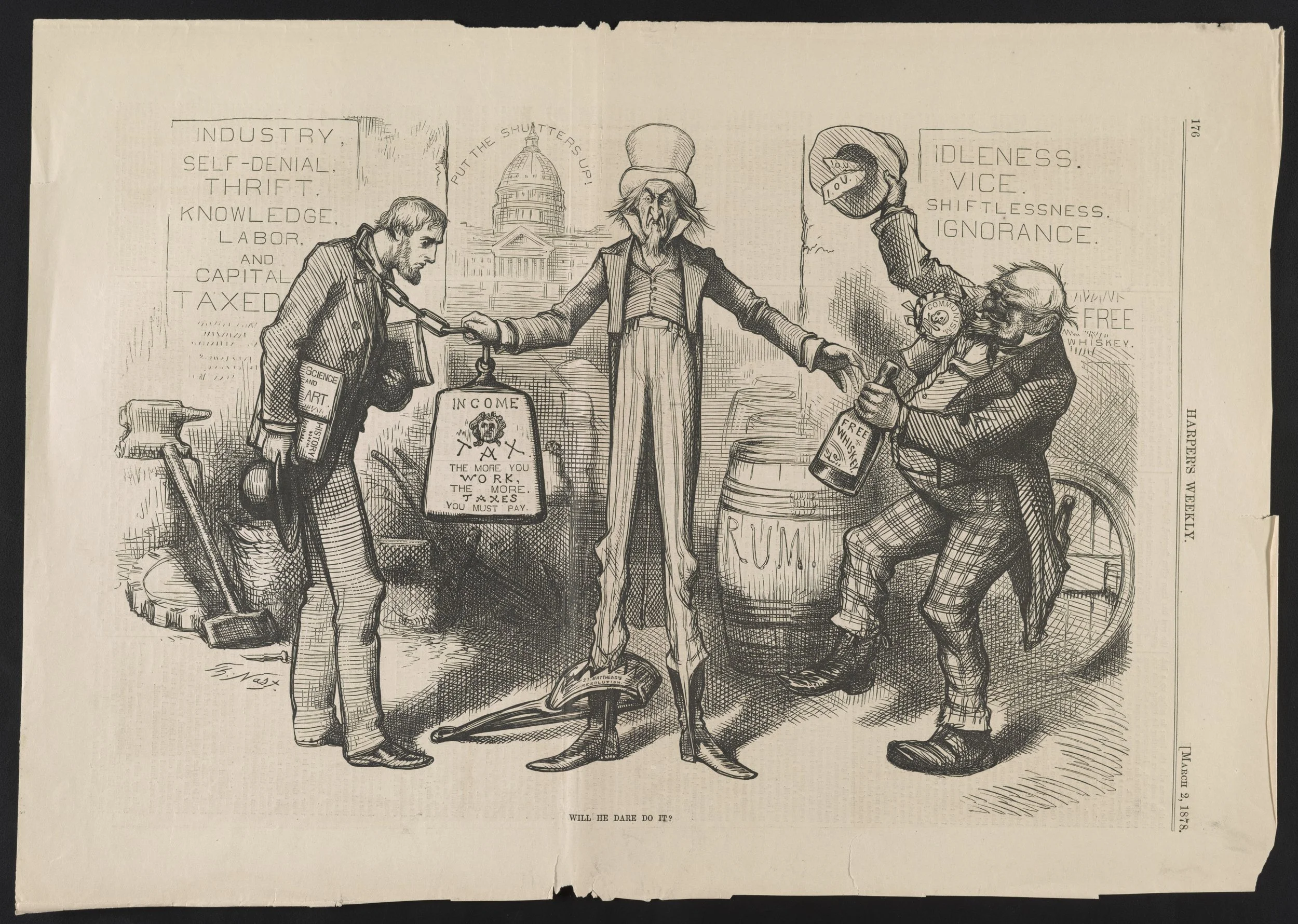
All attributed to: Thomas Nast, Public domain, via Wikimedia Commons



Bibliography:
Ching, Emma. “Thomas Nast: Media Advocacy in an Era of Instability.” ArcGIS StoryMaps. Esri, July 23, 2025. https://storymaps.arcgis.com/stories/48f9751edb5d4c8ba9de962b3d695d7e.
Illustrating Chinese Exclusion. “‘Something That Will Not Blow Over’ – 29 July, 1871,” March 17, 2015. https://thomasnastcartoons.com/irish-catholic-cartoons/something-that-will-not-blow-over-29-july-1971/.
Illustrating Chinese Exclusion. “Early Influences on Thomas Nast,” February 15, 2014. https://thomasnastcartoons.com/selected-cartoons/thomas-nast/.
Illustrating Chinese Exclusion. “Uncle Sam’s Thanksgiving Dinner – Two Coasts, Two Perspectives,” February 16, 2014. https://thomasnastcartoons.com/selected-cartoons/uncle-sams-thanksgiving-dinner-two-coasts-two-perspectives/.
View Archive. “Thomas Nast: Anti-Irish, Anti-Catholic Bigot? – DarylCagle.com.” Darylcagle.com, 2026. https://darylcagle.com/2012/01/09/thomas-nast-anti-irish-anti-catholic-bigot/.
Walfred, Michele. “Thomas Nast and the New Jersey Hall of Fame.” Illustrating Chinese Exclusion, March 2, 2014. https://thomasnastcartoons.com/2014/03/02/thomas-nast-and-the-new-jersey-hall-of-fame/.
Darwin, Charles. The Descent of Man, and Selection in Relation to Sex. London: John Murray, 1871.