
John Quidor:
The Idleness of Rip Van Winkle
A popular trope seen with drunken men is idleness. This was seen often around the late 18th century and into the early 19th century, such as Hogarth's “Industry and Idleness” series and Cruikshank's series “The Bottle”.1,2 This was also a popular story in the United States. This article will discuss the idleness of Rip Van Winkle and his loss of years to Intoxication. This article argues that John Quidor's painting of Rip Van Winkle depicts a clear narrative of generational idleness and alcohol. A painting series that depicts the “like father, like son” depiction, where the apple (or child) literally does not fall from the tree (the parent), a narrative that many ACOAs (Adult Children of Alcoholics) are very aware of and many fear.
The Story of Rip Van Winkle:
Written by Washington Irving in 1819, the story of Rip Van Winkle is about an idle man. His wife was constantly upset at his inability to do anything for her; he and his dog, Wolf, would do anything but support her. He was often titled as Idle and Henpecked due to his wife’s portrayal as overbearing and nagging. 3
“Rip Van Winkle, however, was one of those happy mortals, of foolish, well-oiled dispositions, who take the world easy, eat white bread or brown, whichever can be got with least thought or trouble, and would rather starve on a penny than work for a pound. If left to himself, he would have whistled life away in perfect contentment; but his wife kept continually dinning in his ears about his idleness, his carelessness, and the ruin he was bringing on his family.”
He was not only a husband but a father, his characteristics passing to them as well. The story states:
“His children, too, were as ragged and wild as if they belonged to nobody. His son Rip, an urchin begotten in his own likeness, promised to inherit the habits, with the old clothes, of his father.”
The story then turns to him going on a walk, by himself, into the mountains of the Catskills. There, he ran into a group of strange men dressed as Dutch settlers, he questioned their dress and appearance, but still joined them in their idle games and revelry.4 He drank the spirits that they carried with them and fell into a deep slumber as a result of his consumption of the alcohol. He awakens 20 years later with the entire Revolutionary War having passed, along with his “nagging” wife.5,6 His son, just as Idle as he, even wore the same dirty clothes. Click here for full access to the book.
Washington Irving was a renowned American author. His works are still well known, especially throughout the Catskill Mountains. Many people have painted his vivid stories. One of whom was the painter John Quidor (1801-1881). Little is recorded of Quidor, but there is no doubt of his infatuation with the writer. With leading scholars on him stating, “More than half of Quidor’s surviving paintings, and an even larger percentage of his early works have, as their literary source, the writing of Washington Irving.” For this article, I will focus on two of his paintings, “Rip Van Winkle at Nicholas Vedder’s Tavern” (1839) and “The Return of Rip Van Winkle” (1849)9,10,11 (For those confused on the dates, The Art Institute of Chicago has the date wrong for the painting of his return). 12,13
“Rip Van Winkle at Nicholas Vedder’s Tavern”
John Quidor, Public domain, via Wikimedia Commons

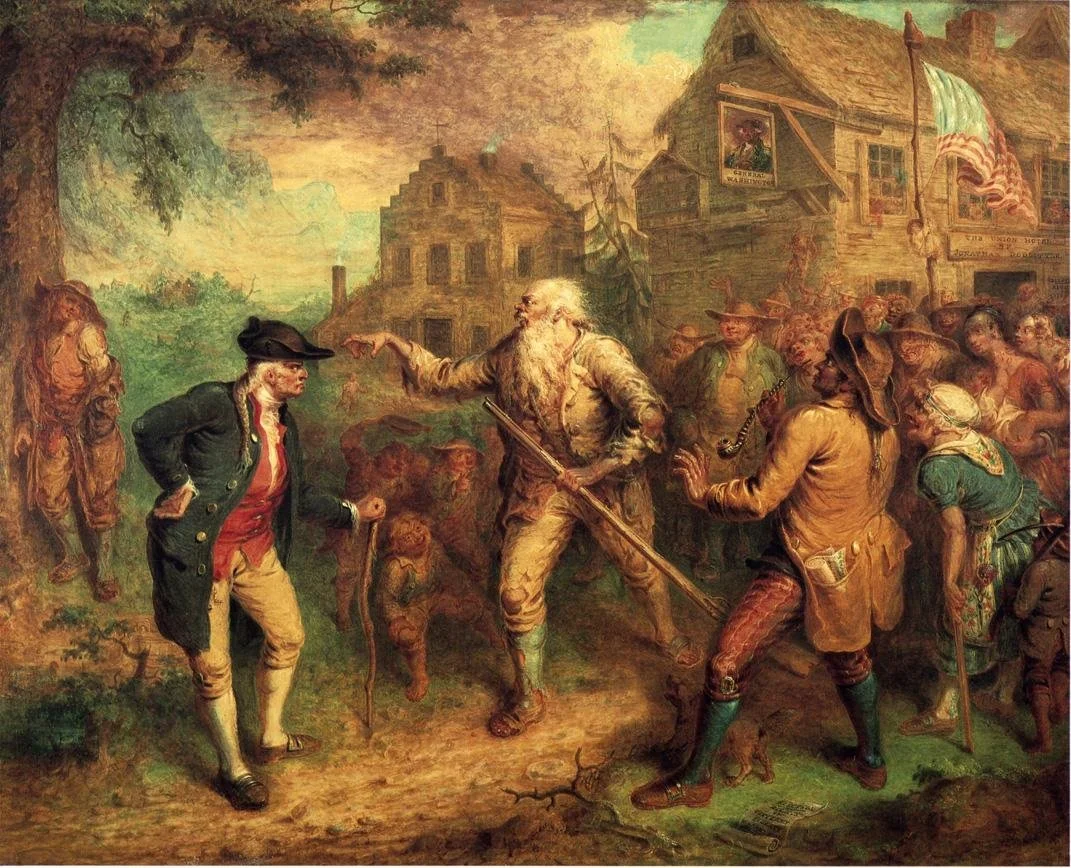
The Return of Rip Van Winkle, 1849, Oil on canvas, 69.9 × 87.3 cm (39 3/4 x 49 13/16 in.) National Gallery of Art
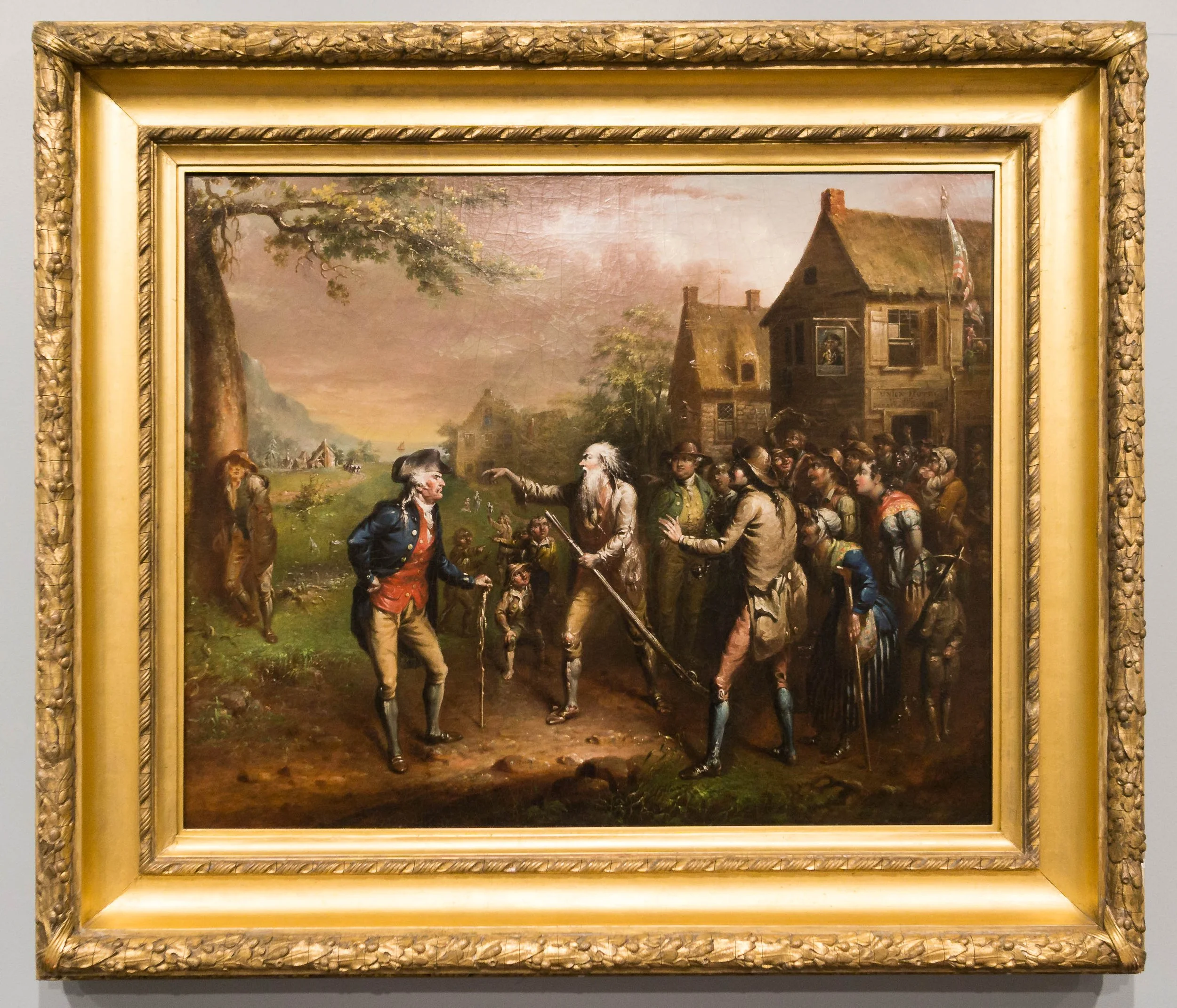
Rip Van Winkle at Nicholas Vedder’s Tavern, 1839, Oil on Canvas, 27 x 34, Museum of Fine Arts, Boston.
“The Return of Rip Van Winkle”
John Quidor, Public domain, via Wikimedia Commons
Quidor completed the paintings 10 years apart. There is no doubt that these paintings are in conversation with each other. I would argue they almost work like a diptych. The second, a completion of the narrative, the artist himself returns. When you conjoin the paintings. The earlier, 1839 painting “Rip Van Winkle at Nicholas Vedder’s Tavern” is placed on the left, and the later 1949 painting “The Return of Rip Van Winkle.” The viewer is made aware of the stark similarities and reflection of the father and son, which is made utterly clear.
The materiality of the artist's physical time jump and absence for 10 years mirrors the time that Rip Van Winkle took before returning to his village, his absence, his age, adding to the painting's meaning. One could argue that the second painting is less clear, far more dazed; it is almost hard to believe that it was painted after 10 more years of painting, education, and practice. This may only add to his narrative of Idleness. Does he himself feel idle in his artistry? What is most intriguing about these works is not the difference in time but the rage that fills the old Rip Van Winkle. This is something rarely pictured in depictions of Rip Van Winkle.14
Rip Van Winkle is a man of idleness and lack of care. He took an interest in the change of time, but this painting’s focus of utter rage while gesturing to his son is of particular fascination. He is seeing so much change; an entire revolution has occurred, and his loyalty to the king must change to loyalty to General Washington. Yet his son is leaning limply against a tree to the edge of the composition, his hat angled, hair long, overcoat hanging off his shoulder, displaying the only difference in attire from his father in the previous painting, the color of his vest is pink instead of a soft blue. The same pink that Rip Van Winkle wears. His left hand shoved into his pocket, his right against the tree, displaying in the same cupping motion that the young Rip Van Winkle has, only young Rip is holding his brand new rifle. In the painting of old Rip Van Winkle's return, the absence of this rifle in the young boy’s hand is clearly stated by this gesture. The rifle, rusted and worn, is instead brandished by the old Rip Van Winkle. His colored vest, this rifle, and his dog are the only distinctions between the two young boys in either painting. Even the trees line up, the brown dirt, and the shrubbery beneath the trees.

“Rip Van Winkle at Nicholas Vedder’s Tavern”
John Quidor, Public domain, via Wikimedia Commons
It is made known that this tree is not the exact same one. Above Rip Van Winkle's head (In both paintings) is the same building. In “The Return of Rip Van Winkle,” there is a dirty, unmaintained church. In this painting, the church is quite visible in the composition. In “Rip Van Winkle at Nicholas Vedder’s Tavern,” it is hidden in the distance, but its cross and steep gabled roof is unmistakable. In this painting, it looks new and well-kept. This shows the clear passage of time from one painting to the next.
In “Rip Van Winkle at Nicholas Vedder’s Tavern,” unlike the church, the tavern takes up most of the composition and has many missing and worn boards. Rip Van Winkle is only in the far right fourth of the picture plane. To his right is a very detailed, very debaucherous group of men sitting outside the tavern. One blowing smoke from his pipe towards a woman inside the tavern door, she is slouched and sleeping at a spinning wheel. Behind her are bottles of alcohol on the counter. Outside are six fairly touchy and nearly homoerotic men, all in states of thorough inebriation.
In “The Return of Rip Van Winkle,” there is a large mass of people, the closest of which has a pipe and is in a true state of shock. All of the townspeople are quite scary in their display of utter interest and eyegoggling, for lack of a better word. Their attention is entirely on the gesturing, tall, presumably loud Rip Van Winkle as he lunges forward, his focus on his supposed son. A son in the same position as he, one he was just like before he went to sleep. So, where is his anger from, and why is it directed at his son?
Well, it has been 20 years, an entire monarchy has fallen in the United States, and a new government has risen, and here he was, and here his son was. Idle, slouched by a tree. His friends are off at Congress or dead. Decades and generations will pass, the drunkard, and the drunkard’s child, and the drunkard’s child’s child, will stand idle as the world evolves without their impact, without their notice, or their remembrance. This is the narrative of Quidor's paintings. A man angry at the passage of time and lack of change in the success, or even physical movement, of himself and his lineage.
John Quidor, Public domain, via Wikimedia Commons
“The Return of Rip Van Winkle”
Notes :
“‘The Bottle,’ Illustrated Panels, George Cruikshank, 1848 ,” Virginia.gov (Document Bank of Virginia, 2026), https://www.lva.virginia.gov/collections/educator-resources/dbva/items/show/220.
“Plate 3, ‘the Bottle. In Eight Plates’ — George Cruikshank’s Cautionary Hogarthian Progress (1847),” Victorianweb.org, 2017, https://victorianweb.org/art/illustration/cruikshank/bottle3.html.
Washington Irving, “The Project Gutenberg EBook of Rip van Winkle, by Washington Irving,” www.gutenberg.org, 1819, https://www.gutenberg.org/files/60976/60976-h/60976-h.htm.
Richard J Zlogar,“‘Accessories That Covertly Explain’: Irving’s Use of Dutch Genre Painting in ‘Rip Van Winkle,” American Literature 54, no. 1 (1982): 48
Wendy Ikemoto, “Putting the ‘Rip’ in ‘Rip Van Winkle’: Historical Absence in John Quidor’s Paired Paintings,” American Art 23, no. 2 (2009):
Washington Irving, “The Project Gutenberg EBook of Rip van Winkle, by Washington Irving,” www.gutenberg.org, 1819, https://www.gutenberg.org/files/60976/60976-h/60976-h.htm.
Christopher Kent Wilson, “John Quidor’s ‘The Return of Rip Van Winkle’ at the National Gallery of Art: The Interpretation of an American Myth,” American Art Journal 19, no. 4 (1987): 1
David M. Sokol, “John Quidor, Literary Painter,” American Art Journal 2, no. 1 (1970): 4
“The Return of Rip van Winkle by John Quidor,” National Gallery of Art, 2025, https://www.nga.gov/artworks/1104-return-rip-van-winkle.
Wendy Ikemoto, “Putting the ‘Rip’ in ‘Rip Van Winkle’: Historical Absence in John Quidor’s Paired Paintings,” American Art 23, no. 2 (2009):
David M. Sokol, “John Quidor, Literary Painter,” American Art Journal 2, no. 1 (1970): 4
Christopher Kent Wilson, “John Quidor’s ‘The Return of Rip Van Winkle’ at the National Gallery of Art: The Interpretation of an American Myth,” American Art Journal 19, no. 4 (1987): 1
John Quidor, “Rip van Winkle,” Art Institute of Chicago, 1829. https://www.artic.edu/artworks/97873/rip-van-winkle.
Ibid.,
Bibliography:
Connecticut History | a CTHumanities Project - Stories about the people, traditions, innovations, and events that make up Connecticut’s rich history. “John Rogers Was a 19th-Century Sculptor for the Common Man - Connecticut History | a CTHumanities Project,” April 23, 2020. https://connecticuthistory.org/john-rogers-was-a-19th-century-sculptor-for-the-common-man/.
Met Museum. “Felix Octavius Carr Darley - Washington Irving’s Illustrations for the Legend of Rip van Winkle, Designed and Etched by F.O.C. Darley - the Metropolitan Museum of Art.” Metmuseum.org, 2026. https://www.metmuseum.org/art/collection/search/339863.
Octavius, Felix. “(Rip van Winkle, Illustration) Rip Serving Liquor to the Strange Men in the Mountains.” Smithsonian American Art Museum, 2026. https://americanart.si.edu/artwork/rip-van-winkle-illustration-rip-serving-liquor-strange-men-mountains-6227.
Quidor, John. “Rip van Winkle.” Art Institute of Chicago, 1829. https://www.artic.edu/artworks/97873/rip-van-winkle.
Irving, Washington. “The Project Gutenberg EBook of Rip van Winkle, by Washington Irving.” www.gutenberg.org, 1819. https://www.gutenberg.org/files/60976/60976-h/60976-h.htm.
Ikemoto, Wendy. “Putting the ‘Rip’ in ‘Rip Van Winkle’: Historical Absence in John Quidor’s Paired Paintings.” American Art 23, no. 2 (2009): 108–30. https://doi.org/10.1086/605711.
Matthew Redmond. “Rip Van Winkle’s Coat: Inheriting the American Republic.” Textes & Contextes, nos. 17–1 (July 2022). https://doi.org/10.58335/textesetcontextes.3546.
Zlogar, Richard J. “‘Accessories That Covertly Explain’: Irving’s Use of Dutch Genre Painting in ‘Rip Van Winkle.’” American Literature 54, no. 1 (1982): 44–62. https://doi.org/10.2307/2925720.
Wilson, Christopher Kent. “John Quidor’s ‘The Return of Rip Van Winkle’ at the National Gallery of Art: The Interpretation of an American Myth.” American Art Journal 19, no. 4 (1987): 23–45. https://doi.org/10.2307/1594499.
Wolf, Bryan. “All the World’s a Code: Art and Ideology in Nineteenth-Century American Painting.” Art Journal 44 (December 1984): 328–37. https://doi.org/10.2307/776769.
Sokol, David M. “John Quidor, Literary Painter.” American Art Journal 2, no. 1 (1970): 60–73. https://doi.org/10.2307/1593866.
Rubin-Dorsky, Jeffrey. “The Value of Storytelling: ‘Rip Van Winkle’ and ‘The Legend of Sleepy Hollow’ in the Context of ‘The Sketch Book.’” Modern Philology 82, no. 4 (1985): 393–406. http://www.jstor.org/stable/437029.
Washingtonpost.Com. “Speaking of Weird, Rip Van Winkle Has Been on My Mind a Lot Lately.” August 7, 2024. EBSCOhost.
Artera.ae. “Rip van Winkle and His Companions at the Inn Door of Nicholas Vedder,” April 27, 2026. https://www.artera.ae/artworks/aeb0daf3-7278-4320-b617-03eb7a8d0805.
b-home Build. “B-Home Build,” 2019. https://www.b-homebuild.com/rip.
Victorianweb.org. “Plate 3, ‘the Bottle. In Eight Plates’ — George Cruikshank’s Cautionary Hogarthian Progress (1847),” 2017. https://victorianweb.org/art/illustration/cruikshank/bottle3.html.
Virginia.gov. “‘The Bottle,’ Illustrated Panels, George Cruikshank, 1848 .” Document Bank of Virginia, 2026. https://www.lva.virginia.gov/collections/educator-resources/dbva/items/show/220.
National Gallery of Art. “The Return of Rip van Winkle by John Quidor,” 2025. https://www.nga.gov/artworks/1104-return-rip-van-winkle.