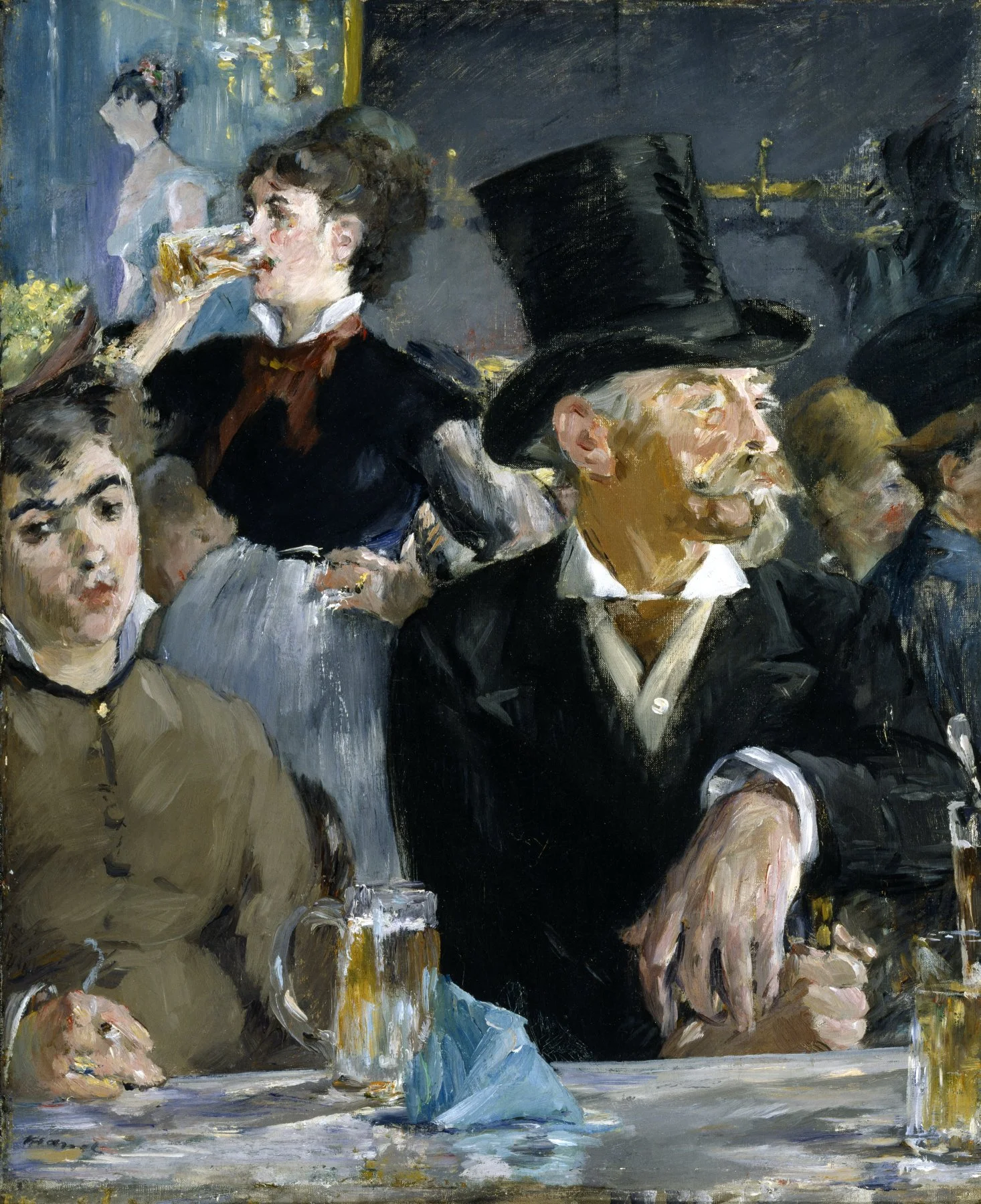
John Singer Sargent:
The “Drunkard” is typically viewed as a man of overindulgence. It is presumed that women were entirely the force behind prohibition, mad at their husbands and finding something to blame. All abstinent and all angry. Women, however, they drink, and they indulge. So how did society view the indulgent woman? Throughout European and U.S. history, women have used inebriation as a statement of independence, self-assertion, and claiming their rightful place in public society. This article will discuss the line of decency held between indulgence of alcohol in the domestic space, versus out in society. This article discusses how the famous portraitist John Singer Sargent pictured women of high society in the late 19th century indulging themselves with a drink.
Women in public spaces:
In the 19th century, it was not appropriate for women, especially those of the middle and upper classes, to drink in public.1 Not only were women meant to be in a domestic role, they, most certainly, were not allowed to indulge themselves in front of the public eye. The purity of women was in their domesticity; their division from this standard was a display of their impropriety.2 Women had many standards they had to follow to fall within the agreeable lines, and public immodesty was not one of them. Drinking is an immodest act.
Drinking was allowed in the domestic space, at private luncheons and specialized, exclusive, close-knit social events where they could be under the watchful eye of men. The further into the public space, the more scandalous. In the later 19th-century women gained more independence, they began working and thus needed to be out in society. Society was not adapting to this new normal and was unable to see women in an independent and self-assertive role.3 Some feared the concept that women would secretly drink during the daytime and, under the advisement of men, should be tested on their temptation to liquor.4
During this time, any notion of “Self assurance, independence, and curiosity were male traits, inappropriate for the weaker sex and her limited sphere.”5 Men feared women's drinking and the independence that it gave them, as men were perfectly allowed to drink with no consequences to their character. Public drinking was one of the things that men were able to do, but women who were pure and easily tempted could not, as they would fall into a path of sin and impropriety. Madam Gautreau could be titled as one of these women. A self-assured woman whose statement in society was one of passion, independence, beauty, and impropriety.
About John Singer Sargent:
John Singer Sargent was a renowned 19th-century portrait painter. By the end of his life, it seemed as though he had painted nearly all of those deemed of social importance in the United States “aristocracy.” Though he was born in Florence, his parents were both Philadelphians and had many American clients.6 One of these was Madame Gautreau, otherwise known as Vidginie Avegne, born in Louisiana. She found herself in Paris with her mother after her father died fighting for the Confederate Army.7 This is where she met her husband, Mr. Gautreau, a seemingly uninteresting Banker. Madame Gautreau herself was a controversial figure in society and a very American presence in France. Part of her society scandal has to do with her lover, a famous gynecologist, Dr. Pozzi, who presumably introduced Gautreau to Sargent. Madame Gautreau loved to perform for society; she was known as an artist in her own persona. Sargent was known to be shy, with a seeming fascination for the societal performers and artists.8
Sargent was a very particular artist. He was notorious for painting his sitters how he decided. Not only was he stubborn with his work, but his paintings were quite the expensive commodity in the day. However, Gautreau was a fascinating subject whom he needed to paint for his own enjoyment.9 The scholar Howat stated Gautreau's interest was "Appropriate for her reputation of attracting men.”10 Sargent was particularly fascinated with her painted lavender skin. Few were asked by him to be painted, and fewer needed to be persuaded. Madam Gautreau was one particularly difficult sitter. Sargent noted “the unpaintable beauty and hopeless laziness of Madame Gautreau” in a letter of his.111 He painted her several times and had numerous studies. Dedicated to the cause of capturing, not only her likeness, but character and nature. Gautreau was quite aware of her image, though a scandalous image at that.
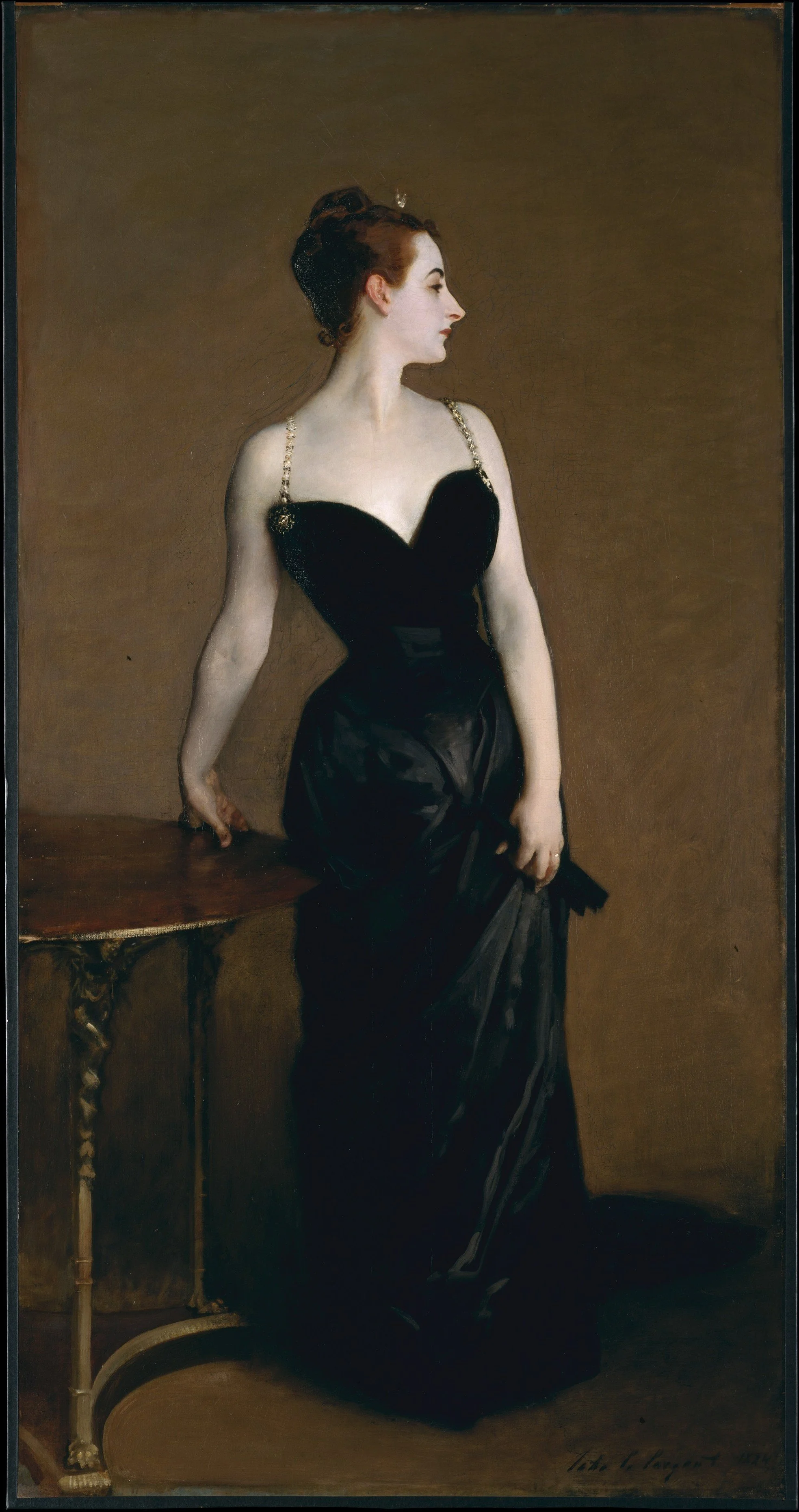
Sargent's favorite, and most infamous painting, is what we now call “Madam X” (1884).12 This portrait, and society's reaction to it, is what allows for the blatantly understood argument of her being a scandalous and self-asserting woman.13 Sargent painted her with unwavering confidence and assertion, with the strap of her dress slipping, leaving her stripped shoulder bare for society to see. This was not something she was upset about, stating herself “Mr. Sargent made a masterpiece of the portrait.”14 The scholar Ordmond notes, “It is significant that the diamond crescent she wears in the portrait, the symbol of the goddess Diana. ...was not Sargent's invention, but an aspect of her own self promotion and display. She seemed to exist in order to be seen and was regarded as a work of art herself.” There was no question that she was quite aware of and complicit in sculpting her display to society. Though her mother was quite in shock. The portrait is displayed without her name, but with her known countenance and likeness; there is no question of the sitter's identity.15
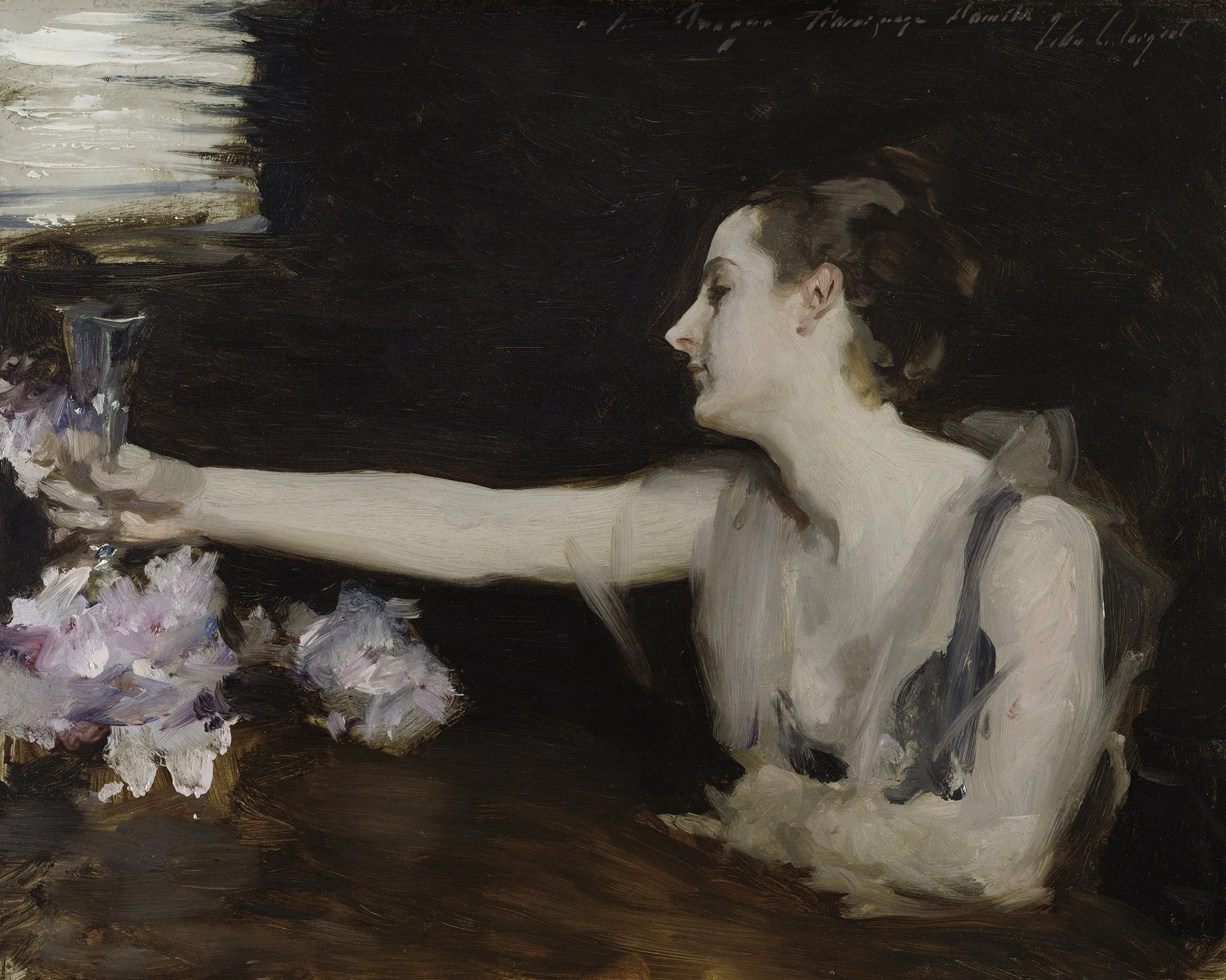
People often forget his first painting of Madam Gautreau, one that I believe is almost more scandalous. Around two years prior to his finishing of “Madam X,” he painted “Madame Gautreau Drinking a Toast.” This portrait was not for the public eye and was instead gifted to Madame Gautreau’s mother by Sargent. This would have been quite the shock to society, if it was shown, as moral women were not painted drinking. Gautreau's drinking alcohol was his first artistic impression, depiction of her likeness, and completion of her character.
John Singer Sargent, Public domain, via Wikimedia Commons
“Madam X”
John Singer Sargent, 1884, Oil on Canvas, 95.7 in x 56.6 in, Metropolitan Museum of Art
John Singer Sargent, Public domain, via Wikimedia Commons
“Madame Gautreau Drinking a Toast”
John Singer Sargent, 1882-1883, Oil on canvas, Oil on panel, 32 x 41 cm (12 5/8 x 16 1/8 in.) Isabella Stewart Gardner Museum
Sargent paints her figure seated at a table facing the viewer. Her left arm frames the edge of the canvas as Madame Gautreau uses it to lean forward into a dark brown gestural table that fades into the dark, figureless background. The dark, warm backround absorbs her brown hair and frames her pale, nearly blue silhouette. Her right hand held staunchly out in a sweeping motion, taking up the entirety of the left half of the picture plane. In her hand, she softly holds out a tall crystal glass that is almost lost in the violet, white, and blue florals that mirror her skin's undertone. Above her glass is a soft, blue, and white-lined gestural window that balances the canvas. Her gaze follows the direction of her glass with perfect indifference. She is casually seated, with a slight slouch, yet her arm is raised with the picture of calm yet steady assertion. She wears a black dress with a similar cut to that seen in Sargent's “Madame X” Portrait. This is covered by a thin gestural veil.
When Sargent depicts women drinking their indulgence is the subject. Her focus is on the glass, the canvas dedicated to her toast. The entire width of the canvas is a sweeping movement of her action. The table rounds as though you, too, may be sitting with her, celebrating. This portrait, though in painting it makes it public to the viewer, is made in private. Not only was it not shown publicly, but there is no one else besides Madame Gautreau. It is believed to be painted in her own home, so she is not lacking the decorum of the domestic space.16 At some point, its display did become far more scandalous as her lover, Dr. Pozzi, acquired the painting for himself.17,18,19 For the man of her affair to purchase a portrait explicitly depicting her in a state of active indulgence is quite scandalous in its display and voyeuristic viewership. Instead of her mother or husband, toasting beside her, it is with her lover. A true act of impropriety of a woman “fallen” from society's demandment of a pure and subservient woman.
John Singer Sargent, Public domain, via Wikimedia Commons
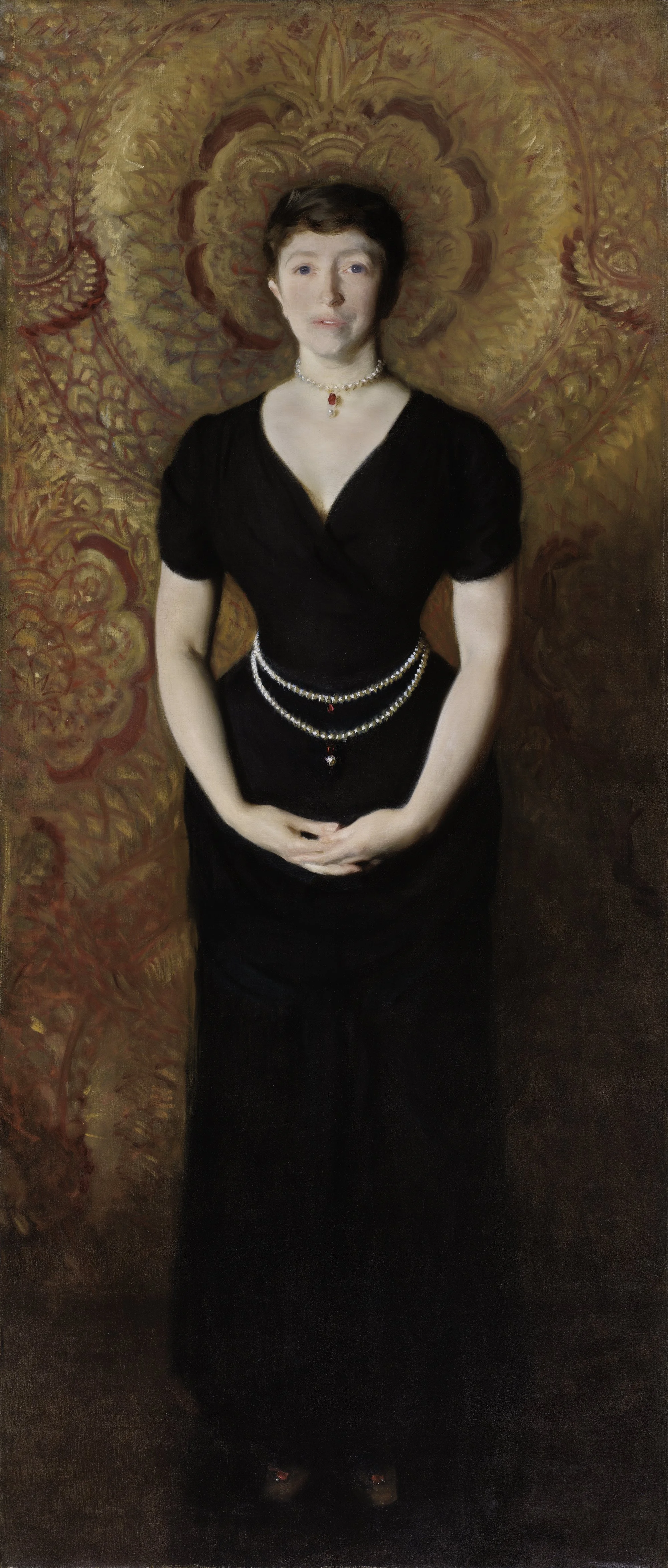
“Isabella Steweart Gardner”
John Singer Sargent, 1888, Oil on canvas, 190 x 80 cm (74 13/16 x 31 1/2 in.), Isabella Steweart Gardner Museum
Isabella Stewart Gardner, a Boston socialite, was truly inspired by the depictions of Madame Gautreau by Sargent. She saw “Madam X” in Sergeant's Studio, which he kept close to him. Only selling the painting after the death of Gautreau. It stayed rightfully displayed in his studio for him to show off and admire.20 Gardner was one of his first supporters in Boston, and after the controversy that came with his scandalous depiction of womanhood.21 Gardner was not unlike Gautreau, herself also having a scandal follow her. It is believed she had her own affair with a young novelist.22 In the end, she bought “Madame Gautreau Drinking a Toast” for her own collection as a memento of her fondness and inspiration for her own portrait by Sargent.23
Madam Gautreau was a woman of scandal to society because of her self-assertion and independence of narrative. Sargent captured her character, of that which leaned into the late 19th-century New Woman. Sargent's depiction of her indulgence rode a line of public display that society questioned. What further scandal would Madam Gautreau have been subjected to with the publication of a private indulgence? What scandal would have come from a portrait of her with the background full of figures at a restaurant? Now, thanks to her contemporary Isabella Stewart Gardner, we can view her toasting, then go out and drink alongside women in restaurants.
John Singer Sargent, Public domain, via Wikimedia Commons
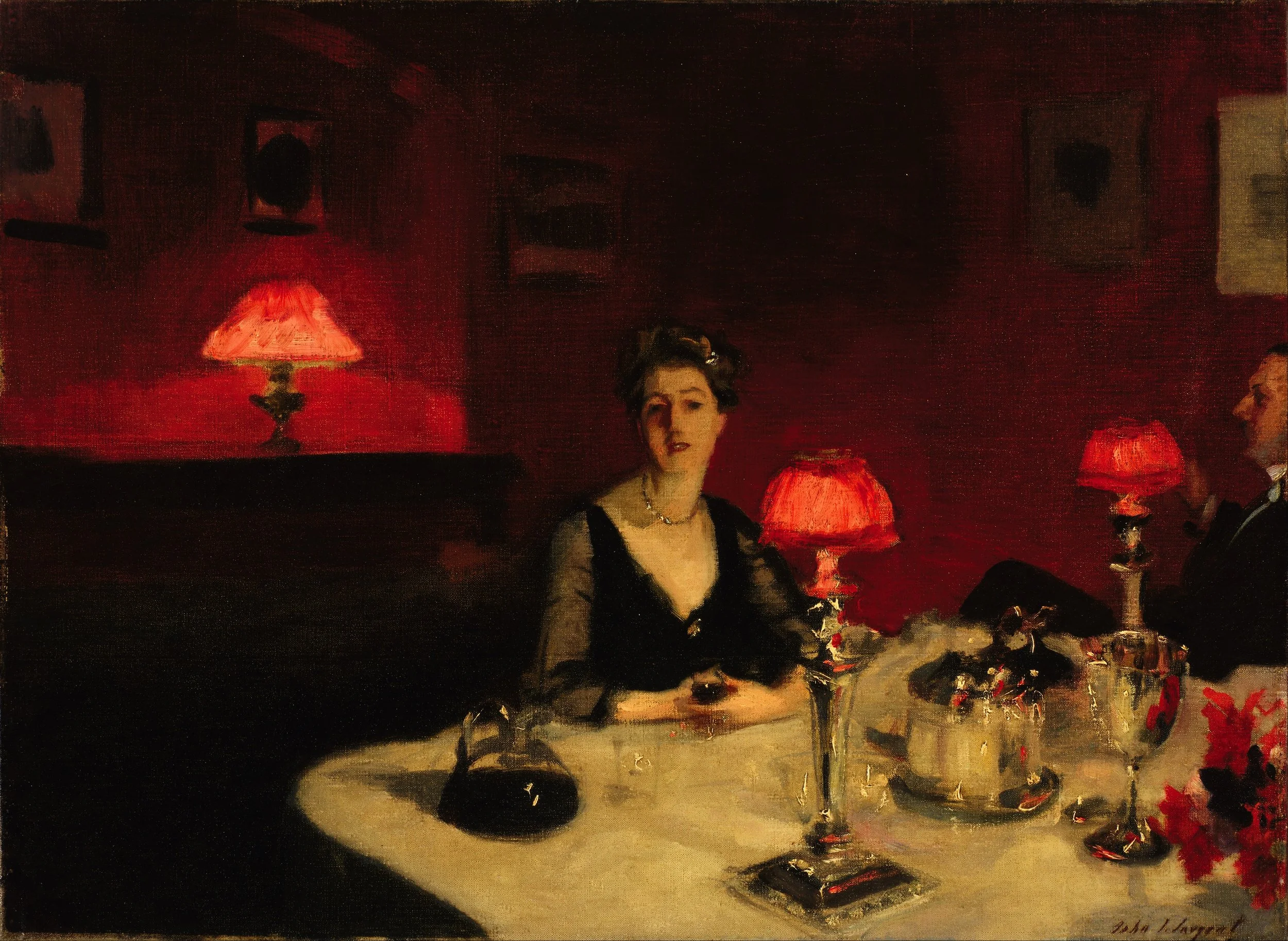
“Le Verre de Porto”
Sargent painted another picture of a woman drinking in “Le Verre de Porto” or “The glass of port.” This scene was set in the private home of his friend, pictured soon after the scandal of “Madam X.” Once again, the subject is a glass of alcohol and the assumed intentions of a woman’s indulgence in the drink, though he is sure to picture part of her husband as well. A private and masculine-controlled environment with no fear of impropriety.
John Singer Sargent, 1884, Oil on Canvas, 95.7 in x 56.6 in, Metropolitan Museum of Art
Notes :
Jan Whitaker, “Women Drinking in Restaurants,” Restaurant-ing through history, January 19, 2020, https://restaurant-ingthroughhistory.com/2020/01/19/women-drinking-in-restaurants/.
Laura Prieto Chesterton, “A Cultural History of Professional Women Artists in the United States, 1830-1930,” Ann Arbor, Mich: UMI Dissertation Services. 1998. Chapter Three
Smith-Rosenburge, Carroll. “The Hysterical Woman: Sex Roles and Role Conflict in 19th-Century America.” Social Research 39, no. 4 (1972): 656.
Thora Hands, The Drinking Cultures of the Higher Classes, Www.ncbi.nlm.nih.gov (Palgrave Macmillan, 2018), https://www.ncbi.nlm.nih.gov/books/NBK524991/.
Smith-Rosenburge, Carroll. “The Hysterical Woman: Sex Roles and Role Conflict in 19th-Century America.” 656.
“John Singer Sargent Letters, 1887-1922 ,” Si.edu (Archives of American Art, Smithsonian Institution , 2025), https://www.aaa.si.edu/collections/john-singer-sargent-letters-9061/biographical-note.
Richard Ormond, and Elaine Kilmurray, John Singer Sargent, Early Portraits, Volume 1: The Early Portraits, Yale University Press New Haven and London, 1998. 113.
Ibid., Intro, 14, 15, 18, and 19.
Richard Ormond, and Elaine Kilmurray, “John Singer Sargent : Complete Paintings,” New Haven: Published for the Paul Mellon Centre for Studies in British Art by Yale University Press. 2014. 9 and 10.
John K. Howat, and Natalie Spassky, “19th-Century America: Paintings and Sculpture,” Google Books, 2026. 178.
Dan Scott, “A Closer Look at Portrait of Madame X by John Singer Sargent,” Draw Paint Academy, August 10, 2019, https://drawpaintacademy.com/madame-x/.
Richard Ormond, and Elaine Kilmurray, John Singer Sargent, Early Portraits, Volume 1: The Early Portraits, Yale University Press New Haven and London, 1998. 114.
Susan Sidlauskas, “Painting Skin: John Singer Sargent’s ‘Madame X,’” American Art 15, no. 3 (2001):
Richard Ormond, and Elaine Kilmurray, John Singer Sargent, Early Portraits, Volume 1: The Early Portraits, Yale University Press New Haven and London, 1998. 114.
Ibid., 114
Ibid.,117
Dan Scott, “A Closer Look at Portrait of Madame X by John Singer Sargent,” Draw Paint Academy, August 10, 2019.
“Madame Gautreau Drinking a Toast,” Gardnermuseum.org (ISGM, 2018), https://www.gardnermuseum.org/experience/collection/10979.
Susan Sidlauskas, “Painting Skin: John Singer Sargent’s ‘Madame X,’” American Art 15, no. 3 (2001):
Richard Ormond, and Elaine Kilmurray, John Singer Sargent, Early Portraits, Volume 1: The Early Portraits, Yale University Press New Haven and London, 1998. 114.
Richard Ormond, and Elaine Kilmurray, “John Singer Sargent : Complete Paintings,” New Haven: Published for the Paul Mellon Centre for Studies in British Art by Yale University Press. 2014. 81
Ibid., 81
“Madame Gautreau Drinking a Toast,” Gardnermuseum.org (ISGM, 2018), https://www.gardnermuseum.org/experience/collection/10979.
Bibliography
Baker, Frederick D, and Elsa Smithgall. Museo d’arte moderna Ca’ Pesaro. William Merritt Chase : A Modern Master. The Phillips Collection, 2016. EBSCOhost.
Broude, Norma. “Mary Cassatt: Modern Woman or the Cult of True Womanhood?” Woman’s Art Journal 21, no. 2 (2000): 36–43. https://doi.org/10.2307/1358749.
Burns, Sarah, and John Davis. 2009. “American Art to 1900 : A Documentary History / Sarah Burns and John Davis.” Berkeley: University of California Press.
FAMSF. “Le Verre de Porto (a Dinner Table at Night),” 2018. https://www.famsf.org/artworks/le-verre-de-porto-a-dinner-table-at-night.
Floryan, Meg. “John Singer Sargent, Madame X (Madame Pierre Gautreau) – Smarthistory.” smarthistory.org, August 9, 2015. https://smarthistory.org/sargent-madame-x-madame-pierre-gautreau/.
Fuller, Margaret. Woman in the Nineteenth Century. The Project Gutenberg EBook, 1845.
Gardnermuseum.org. “Madame Gautreau Drinking a Toast.” ISGM, 2018. https://www.gardnermuseum.org/experience/collection/10979.
Hands, Thora. “The Secret Army of Drinkers.” www.ncbi.nlm.nih.gov. Palgrave Macmillan, June 19, 2018. https://www.ncbi.nlm.nih.gov/books/NBK524993/.
Harvard. “The Breakfast Table | Harvard Art Museums.” Harvardartmuseums.org, 2026. https://harvardartmuseums.org/collections/object/299794.
———. “The Secret Army of Drinkers.” www.ncbi.nlm.nih.gov. Palgrave Macmillan, June 19, 2018. https://www.ncbi.nlm.nih.gov/books/NBK524993/.
Herdrich, Stephanie L. Sargent and Paris. Metropolitan Museum of Art, 2025.
Herdrich, Stephanie L. “Sargent : The Masterworks ” New York: Rizzoli Electa, a division of Rizzoli International Publications, Inc. 2018.
Hirshler, Erica E, Caroline Corbeau-Parsons, James Finch, Pamela A. Parmal, Paul Fisher. “Fashioned by Sargent” Boston: MFA Publications, Museum of Fine Arts, Boston. 2023.
Howat, John K., and Natalie Spassky. “19th-Century America: Paintings and Sculpture.” Google Books, 2026. https://books.google.com/books?id=K3DAMa0JdbEC&printsec=frontcover#v=onepage&q&f=false.
Koogler, Marion, and Holly Pyne Connor . Off the Pedestal New Woman in the Art of Homer, Chase, and Sargent . New Jersey: Rutgers University Press, 2006.
McClellan, Michelle Lee. “Lady Lushes”: Women Alcoholics in American Society, 1880-1960, 2000.
Ormond, Richard, and Elaine Kilmurray. John Singer Sargent, Complete Paintings, Volume 1: The Early Portraits. Yale University Press New Haven and London, 1998.
Ormond, Richard, Elaine Kilmurray, and John Singer Sargent. “John Singer Sargent: Complete Paintings” New Haven: Published for the Paul Mellon Centre for Studies in British Art by Yale University Press. 2014.
Prieto, Laura R. At Home in the Studio: The Professionalization of Women Artists in America. Harvard University Press, 2001. https://doi.org/10.2307/j.ctv322v4sw.
Promey, Sally M. Painting Religion in Public: John Singer Sargent’s Triumph of Religion at the Boston Public Library. Princeton University Press, 2001. EBSCOhost.
Scott, Dan. “A Closer Look at Portrait of Madame X by John Singer Sargent.” Draw Paint Academy, August 10, 2019. https://drawpaintacademy.com/madame-x/.
Si.edu. “John Singer Sargent Letters, 1887-1922 .” Archives of American Art, Smithsonian Institution , 2025. https://www.aaa.si.edu/collections/john-singer-sargent-letters-9061/biographical-note.
Sidlauskas, Susan. “Painting Skin: John Singer Sargent’s ‘Madame X.’” American Art 15, no. 3 (2001): 9–33. https://www.jstor.org/stable/3109402.
Smith-Rosenburge, Carroll. “The Hysterical Woman: Sex Roles and Role Conflict in 19th-Century America.” Social Research 39, no. 4 (1972): 652–78. http://www.jstor.org/stable/40970115.
Whitaker, Jan. “Women Drinking in Restaurants.” Restaurant-ing through history, January 19, 2020. https://restaurant-ingthroughhistory.com/2020/01/19/women-drinking-in-restaurants/.