George Catlin:
Depicting the Inherent Alcoholism of the “Noble Savage”
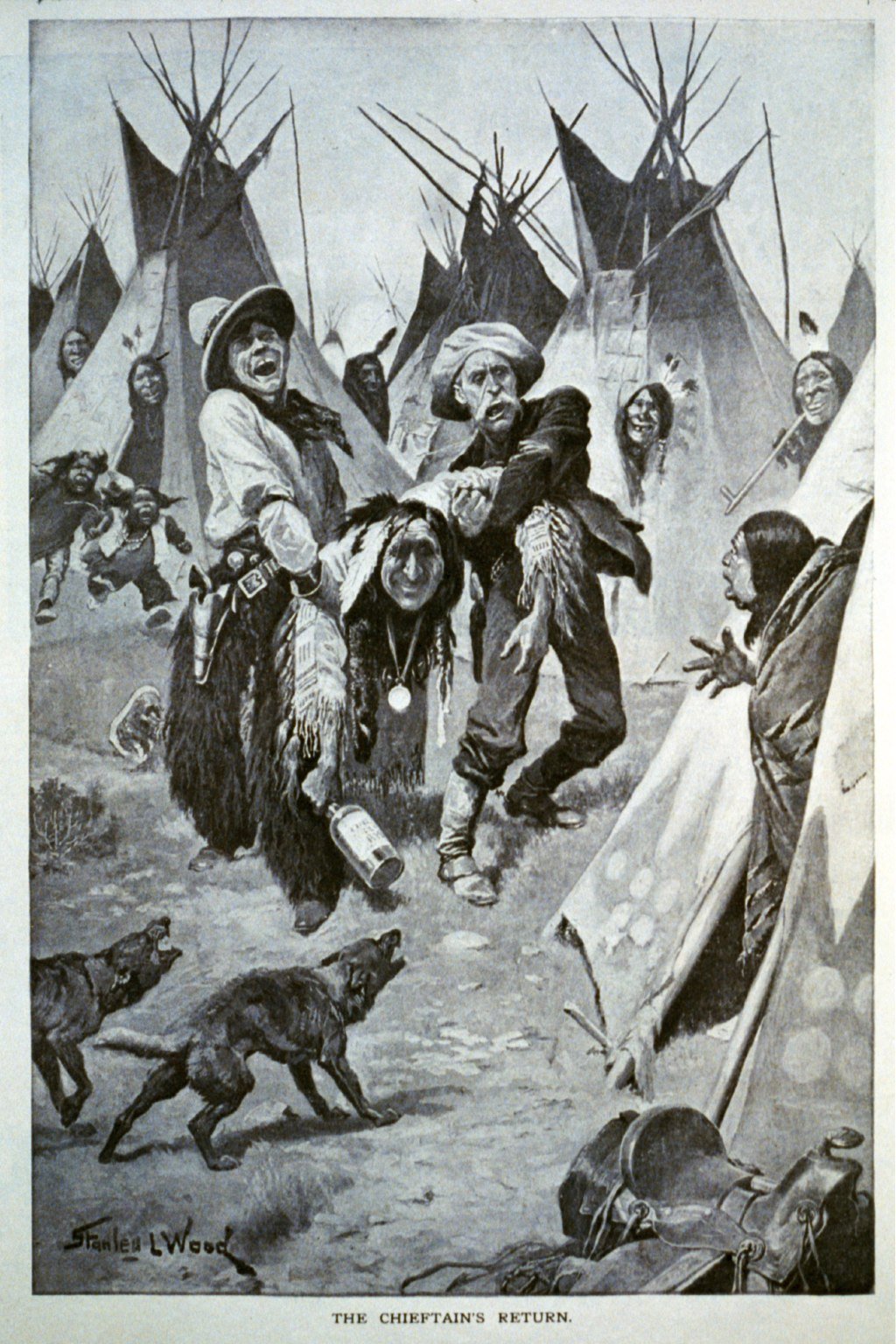
“Perhaps no stereotype has been so long-lasting and so thoroughly ensconced in our social fabric as that of the ‘drunken Indian.’” This quote by Joseph Westermeyer points to why it is imperative to discuss the imagery of Indigenous people and the effects of settler colonial drinking culture.
This article will demonstrate how George Catlin's romanticized portraits of the “Noble Savage” were still used to portray a narrative of the “drunken Indian” and Indigenous peoples' inherent inability to control their inhibitions when it came to alcohol. I will do this by analyzing two portraits of Indigenous Chiefs from the Ottawa and Seminole Nations by George Catlin, each of which is accompanied by his discussion of their intoxication and need for alcohol. This website is about Inebriation in Art; neither of these people are physically depicted in the act of drinking, nor is their alcohol in the portraits. However, they are described by Catlin in a manner that results in many scholars labeling them, in current terms, as alcoholics.
*This article uses the term Indigenous to refer to a generalized (in this case North American) Native American population when one's specific Nation (colonially known as Tribe) title is not applicable. You will see the term “Indian” in much of the cited scholarship; this is also in reference to American Indigenous people (not in reference to people from the country of India), but is currently deemed to be a derogatory term by Indigenous Communities due to its historical usage by non-Indigenous people.*
*To clarify: when stating “inherent addiction,” this article does not argue that Indigenous people are inherently addicted to substances. That is not a proven belief. Instead, it is incredibly derogatory to believe without evidence. This article argues that George Catlin, the painter and surrounding white society, did believe this at the time. It uses Catlin's visual portrayals as evidence for this argument.
Alcohol was present on Turtle Island (the Americas) since before its colonization. It is known that (now referred to colloquially) North American Indigenous societies used fermented beverages, though their use was often dictated by season and various rituals.1,2 When Europeans came to Turtle Island, they brought their incredibly intoxicating drinking patterns with them.3 During colonial expansion, whiskey was a cheap trade from the colonizers to Indigenous people.
The cheap trade of whiskey quickly and pervasively devastated many Indigenous Communities. This began the stereotype of the “drunken Indian”. The continuously fostered idea that Indigenous communities (or their “race”) are unable to “hold their alcohol,” unable to control themselves when it comes to alcohol, and inherently alcoholics. Current studies have found that Indigenous people do not have a biological predisposition to alcoholism. It is viewed as a sociocultural change, not a lack of metabolism throughout the “race” of the North American Indigenous communities. 4,5,6
The settler colonial population drank quite heavily at this time; it came with their “culture”. As they continued on their path to “civilize,” they passed on their drinking habits. Indigenous communities were experiencing forced migration and the death of much of their population, so many needed a coping mechanism. This, and constant and unritualistic access to alcohol that colonial settlers brought, are the contemporary known contributors to the increase of drinking habits in Indigenous people. The “drunken Indian” stereotype came along as a way to create racial differentiation.7 Particularly one that can be portrayed in a “degenerative” or disease-like way.
There were efforts to stop the Whiskey trade in hopes of mitigating its effects on indigenous communities, but it served as beneficial to Colonization and the occupation of Turtle Island; many of these efforts were unsuccessful.8 In 1832, the federal government placed a ban on the sale of alcohol to indigenous communities, but this did nothing to help. It did create a narrative of false effort from the government, further adding to the created concept that indigenous people are hopeless in the fight against addiction.9

George Catlin, Public domain, via Wikimedia Commons
“Map Showing Indian Localities in North America”
His first trip west was made under the guidance of William Clark, of Louis and Clark. He made a total of four trips throughout his life. During which he captured over 437 paintings, more than 300 of which were individual portraits, each painted on the spot.15 Some scholars have differing opinions on his intentions for creating his paintings. Some view him as a true appreciator of Indigenous communities, others as a key contributor to the stereotype of the “Noble Savage.”16
It is hard to argue against Catlin’s depictions, not only adding to, but being a staple of the “Noble Savage” visualized caricature. His paintings convey utter romanticism, his letters, a stream of constant verbiage of his fear of civilizing forces destroying Indigenous culture. Charles Dickens even wrote his “Noble Savage” essay right after visiting Catlin’s Indian Picture Gallery exhibition.17,18 Catlin's paintings romanticize and create a narrative of the pure, native, untouched nobility of the Indigenous North American people.In this quote, the scholar describes Catlin's intentions, stating:
“He believed that americas native peoples, one proud “Noble Savages,” were being destroyed by advancing civilisation. Of the “two classes of Indian Society" he wrote “the one nearest to civilisation… has become degraded and impoverished, and their character changed be civilised teaching, and their worst passions inflamed, and jealousies excited be the abuses practiced amongst them.” Such was “the semi-civilized and the degraded condition of the savage… my labors have generally commenced where the state of civilization leave off.”19
Catlin sought to capture their natural nobility before it was taken away by civilizing forces (such as whiskey).
George Catlin was a Pennsylvania lawyer turned artist.10 Catlin was known for his passion and goal of documenting the likeness of all Indigenous people in North America and beyond.11 Catlin stated, “Nothing short of the loss of my life shall prevent me from visiting their country, and of becoming their historian.”12,13 Through his art and letters, Catlin documented his unwithheld views on Indigenous North American peoples' addiction and whiskey use and colonial trading practices.
“The Indians of North America...were once a happy and flourishing people...were sixteen millions in numbers....The country was entered by white men...and thirty million of these are now scuffling for the goods and luxuries of life, over the bones and ashes of twelve million of red men; six millions of whom have fallen victims to the small-pox, and the remainder to the sword, the bayonet, and whiskey.... Of the two million remaining alive at this time, about 1,400,000 are already the miserable living victims and dupes of white man's cupidity, degraded, discouraged, and lost in the bewildering maze that is produced by the use of whiskey and its concomitant vices; and the remaining number are yet unaroused and unenticed from their wild haunts or their primitive modes, by the dread or love of white man and his allurements.”14
George Catlin, 1833, unknown dementions, Private Collection
William Merritt Chase, Public domain, via Wikimedia Commons

“Mick-e-no-páh, Chief of a Tribe”
I will be discussing two portraits by him, a chief of the Ottawa (or odawa) indigenous nation, and a Chief of the Seminole. Neither depicts the active usage of alcohol, but he refers to their character in terms of their drinking habits. Each figure is seated, the right side of their body displaying their garmentry, their left wrapped with a soft fur blanket-like shawl that they each firmly secure to themselves. Their fist in a steady hold placed at their sternum. Each has a blotchy tan, brown and blue background, with the Seminole Chief Mick-e-no-páh sitting on unfinished rocks that have sharp creases mimicking the white fabric he holds so tightly in his grasp. Mick-e-no-páh is in a full-length portrait, as he requested to be painted only if his legs were of perticular focus.20
Catlin certainly followed his request, painting the bright red fabric running down his legs that Catlin describes as “leggings,” each with intricate brown and black bands with white borders tied around his calves, forcing the viewer's gaze, the detail and intricacy unmatched anywhere else in the painting. Catlin depicts Mick-e-no-páh with many layers of patterned and pleated clothing, each made visible to the viewer. Catlin described him as not only the head of the chiefs of the tribe but also as
“a very lusty and dignified man. He took great pleasure in being present every day in my room, whilst I was painting the others; bet positively refused to be painted, until he found a bottle of whiskey, and another of wine which I keep on my mantlepiece… were only to deal out their occasional kindness to those who sat for their portraits; when he at length agreed to be painted.”21
Though it is unclear what Catlin particularly means by the term "lusty," his affections for this man are made clear. His statement that Mick-e-no-páh watched many portraits be painted and had an obvious fascination but a clear disinterest in being pictured himself, with his interests only changing with the prospect of alcohol, suggests Mick-e-no-páh’s immediate change of attitude for a drink.
His initial refusal to sit was not due to lack of time or uninterest in the practice, so things were not in flux, but a more personal refusal, that is, until his described innate temptation overcame his previous positioning on the subject. This portrait by Catlin depicts his view of the unburdened nobility of the Indigenous persons. His stature is strong, his hand clenched, his face smooth and dignified, looking directly into the viewer's gaze. Pictured as noble, though his inherent predisposition to alcohol still stands. Still dignified, as he lacks unbridled access to whiskey. The alcohol is instead contained on the mantle to be handed out as payment, in small portions, to those Catlin deems unfit to control their natures.
George Catlin, 1838, oil on canvas, 29 x 24 in. (73.7 x 60.9 cm), Smithsonian American Art Museum,
Catlin's portrait of Shin-gós-se-moon, on the other hand, depicts a man impacted by the ruins of indigenous access to whiskey. Catlin describes Shin-gós-se-moon as “Blind in one eye. The effects of whiskey and civilization are plainly discernible in this instance.” To Catlin, he is depicting the “drunken Indian.” A man whose body has deteriorated, assimilating his drunkenness with his disability.
It is presumed that Catlin painted Shin-gós-ee-moon on the island of Mackinac in Lake Huron, which is currently in the state of Michigan. It was a hot spot for Indigenous and European trade. Shin-Gós-Ee-Moon was a Chief of the Ottawa (Odawa) Nation, which inhabits the Great Lakes region.22 This meant that in Catlin's eyes, the Ottawa Nation was further civilized due to their contact and consistent trade with Europeans. The Seminoles were less intertwined culturally with settler colonial people at this time.

George Catlin, 1836?, oil on canvas, 29 x 24 in. (73.7x 60.9 cm), Smithsonian American Art Museum,
“Shin-gós-se-moon, Big Sail, a Chief”
Catlin's portrait of Shin-gós-ee-moon, or “Big Sail, A Chief," was made in the later years of his expeditions. In a caption describing the portrait a scholar states “It is more likely, too, that such a perceptive and sympathetic response to Indian dissipation would have come at the end of Catlin's travels.”23 Essentially stating that the visible effects of whiskey and civilization have already permeated the subject's (Big Sail’s) nobility. He even has an English language name, in the title of the portrait, whereas Mick-e-no-páh does not. Nevertheless, Catlin's romanticism of the subject causes him to still try to capture what was left of his natural state before he has been, what Catlin would view as, fully corrupted. Through his brush strokes, the viewer can see the obvious focus that Catlin has in depicting the effects of alcohol on the sitter's body.
Catlin’s painting puts heavy emphasis on the sitter's disability. His body slouched at a three-quarter turn, and his face angled slightly down to follow the position of the sitter's left eye, holding a distant and foggy look. The cornea itself is covered in a grey circle reminiscent of single eye cataracts. Current data states that heavy daily drinking can result in an increased likelihood of getting cataracts. Meaning his blindness could have been a bodily effect of alcohol consumption.24 His right eye looks to the left of the viewer, his iris at the corner of his eye, facing the opposite angle of his body. His single eyebrow raised, the wrinkles undulating across his forehead, his skin looking as though it is melting off his bones.
Catlin put every effort into showing the asymmetricality of Shin-gós-se-moon’s eyes, the most detail in the wrinkles of his skin. Not the layer of fabric on his body, instead, he has a simple white undershirt. A black cloak in which his dark hand loosely holds. He also has a large circular silver medallion on a red string tied around his neck. This may be a medallion or some sort of important jewellery piece. However, the inscription is merely gesturally made by Catlin and is undescribed in his letters. His focus is no longer on attire but worn-out skin. Scholars have since referred to Shin-gós-se-moon as an alcoholic, though the term was not coined during the creation of the paintings.25,26,27 Catlin’s paintings of the Indigenous “Noble Savage” are inherently viewed by European and settler colonial people as images of the “drunken Indian” due to the belief in their predisposition to addiction.
I argue that Catlin's goal is to paint them before his romanticized view of their “natural purity” is, what he would believe to be, completely degraded by alcohol consumption. He views them as helpless in succumbing to the corrupting spirits that come along with civility, in need of a historian to capture their likeness before they are lost to addiction. These portraits of two men each are at different stages of cultural immersion. Mick-e-no-páh, still dignified though his "inherent" need for alcohol is written as the reasoning we have this portrait today. Big Sail, a further colonized man who's face is painted with the effects of alcohol.
It may seem contradictory that the drinking of whiskey comes with the one being civilized, due to other discussions of alcohol in these case studies, where I argue for the 19th-century notion that alcohol reveals the savage and sinful nature of the wanted "other". However, Europeans at the time drank heavily; due to this, alcohol was something that had to come with “civilized” culture. Catlin’s paintings and associated letters show us that, though both “races” drank heavily, it was the belief that the Indigenous person's inherent predisposition to addiction that distinguished the "races". Thus, Catlin feared their civilization, and their inevitable submission to alcohol, and therefore the loss of nobility.
Notes :
Joan Weibel-Orlando, "American Indians and Prohibition: Effect of Affect - Views from the Reservation and the City," Contemporary Drug Problems 17, no. 2 (1990): 294
Pacific Standard Staff, “What’s behind the Myth of Native American Alcoholism?,” Pacific Standard, October 10, 2016, https://psmag.com/news/whats-behind-the-myth-of-native-american-alcoholism/.
Paul Aaron and David Musto, “Temperance and Prohibition in America: A Historical Overview,” Nih.gov (National Academies Press (US), 2016), https://www.ncbi.nlm.nih.gov/books/NBK216414/.
Pacific Standard Staff, “What’s behind the Myth of Native American Alcoholism?,”
Joseph Westermeyer, "‘The Drunkin Indian’ Myths and Realities." Psychiatric Annals 4, no. 11 (11, 1974): 29-31,35-36.
Arieahn Matamonasa-Bennett, “‘The Poison That Ruined the Nation’: Native American Men—Alcohol, Identity, and Traditional Healing.” American Journal of Men’s Health 11, no. 4 (March 26, 2015)
Keaton Pregozen, “Addiction as a Bio-political Tool: The ‘Drunken Indian’ Stereotype and the Politics of Removal in 19th-century United States,” Central European University, 2025. 294, 195.
Joan Weibel-Orlando, "American Indians and Prohibition: Effect of Affect - Views from the Reservation and the City," Contemporary Drug Problems 17, no. 2 (1990): 294 and 195.
Pacific Standard Staff, “What’s behind the Myth of Native American Alcoholism?,”
Mary Sayre Haverstock, Indian Gallery (New York : Four Winds Press, 1973).
Harold McCracken, George Catlin and the Old Frontier (New York: Dial Press, 1959), 129.
Brian W Dippie and Christopher Mulvey, George Catlin and His Indian Gallery (Washington, D.C. : Smithsonian American Art Museum ; New York : W.W. Norton, 2002).
Bruce Watson, “George Catlin’s Obsession,” Smithsonian Magazine, December 2002, https://www.smithsonianmag.com/arts-culture/george-catlins-obsession-72840046/.
“Indian Haters and Sympathizers,” DigitalHistory.Uh.edu, 2021, https://www.digitalhistory.uh.edu/disp_textbook.cfm?smtid=3&psid=671.
Brian W Dippie and Christopher Mulvey, George Catlin and His Indian Gallery (Washington, D.C. : Smithsonian American Art Museum ; New York : W.W. Norton, 2002).
John Hausdoerffer, Catlin's Lament: Indians, Manifest Destiny, and the Ethics of Nature (Lawrence: University Press of Kansas, 2009)
Facing History and Ourselves, “From ‘Noble Savage’ to ‘Wretched Indian’ ,” www.facinghistory.org (Facing History and Ourselves: Canada, September 20, 2019), https://www.facinghistory.org/en-ca/resource-library/noble-savage-wretched-indian.
Robert M. Lewis, “Wild American Savages and the Civilized English: Catlin’s Indian Gallery and the Shows of London,” European Journal of American Studies 3, no. 1 (January 21, 2008), https://doi.org/10.4000/ejas.2263.
Brian W Dippie and Christopher Mulvey, George Catlin and His Indian Gallery (Washington, D.C. : Smithsonian American Art Museum ; New York : W.W. Norton, 2002). 14.
William H. Truettner, “The Natural Man Observed: A Study of Catlin's Indian Gallery,” Smithsonian Institute Press, 1979. 227.
Ibid., 199
ottawatribe, “We Are the Ottawa Tribe of Oklahoma,” https://ottawatribe.gov/, 2025, https://www.ottawatribe.gov.
Yu Gong et al., “Different Amounts of Alcohol Consumption and Cataract,” Optometry and Vision Science 92, no. 4 (April 2015): 471–79, https://doi.org/10.1097/opx.0000000000000558.
Elvin Morton Jellinek, “MAGNUS HUSS. Alcoholismus Chronicus,” Rutgers University Quarterly Journal of Studies on Alcohol , January 1, 1943. https://doi.org/10.7282/t3-vmth-yx45.
Brian W Dippie and Christopher Mulvey, George Catlin and His Indian Gallery (Washington, D.C. : Smithsonian American Art Museum ; New York : W.W. Norton, 2002). 198
George Catlin, “Mick-e-No-Páh, Chief of the Tribe,” Smithsonian American Art Museum, 2026, https://americanart.si.edu/artwork/mick-e-no-pah-chief-tribe-4273.
Bibliography
Aaron, Paul, and David Musto. “Temperance and Prohibition in America: A Historical Overview.” Nih.gov. National Academies Press (US), 2016. https://www.ncbi.nlm.nih.gov/books/NBK216414/.
Catlin, George. Letters and Notes on the Manners, Customs, and Condition of the North American Indians.Internet Archive. Vol. 2. Internet Archive, 1841. https://archive.org/details/b33283795_0002/page/n3/mode/2up.
———. “Mick-e-No-Páh, Chief of the Tribe.” Smithsonian American Art Museum, 2026. https://americanart.si.edu/artwork/mick-e-no-pah-chief-tribe-4273.
Crouse, Russel. Mr. Currier and Mr. Ives: A Note on Their Lives and Times. Garden City, NY: Garden City Publishing Co., 1930.
DigitalHistory.Uh.edu. “Indian Haters and Sympathizers,” 2021. https://www.digitalhistory.uh.edu/disp_textbook.cfm?smtid=3&psid=671.
Dippie, Brian W, and Christopher Mulvey. George Catlin and His Indian Gallery. Washington, D.C. : Smithsonian American Art Museum ; New York : W.W. Norton, 2002.
Duffes, Melissa. “Revisiting America : The Prints of Currier & Ives / Edited by Melissa Duffes.” Omaha, Nebraska: Joslyn Art Museum. 2020
Facing History and Ourselves. “From ‘Noble Savage’ to ‘Wretched Indian’ .” www.facinghistory.org. Facing History and Ourselves: Canada, September 20, 2019. https://www.facinghistory.org/en-ca/resource-library/noble-savage-wretched-indian.
Federal Judicial Center. “Native Prohibition .” www.fjc.gov, n.d. https://www.fjc.gov/history/spotlight-judicial-history/native-prohibition.
Gong, Yu, Kehong Feng, Ning Yan, Yong Xu, and Chen-Wei Pan. “Different Amounts of Alcohol Consumption and Cataract.” Optometry and Vision Science 92, no. 4 (April 2015): 471–79. https://doi.org/10.1097/opx.0000000000000558.
Hausdoerffer, John. Catlin's Lament: Indians, Manifest Destiny, and the Ethics of Nature. Lawrence: University Press of Kansas, 2009.
Haverstock, Mary Sayre. Indian Gallery. New York : Four Winds Press, 1973.
Jellinek, Elvin Morton. “MAGNUS HUSS. Alcoholismus Chronicus.” Rutgers University Quarterly Journal of Studies on Alcohol , January 1, 1943. https://doi.org/10.7282/t3-vmth-yx45.
Joseph, Bob. “A Look at First Nations Prohibition of Alcohol.” Ictinc.ca, October 20, 2016. https://www.ictinc.ca/blog/first-nations-prohibition-of-alcohol.
Kross, Jessica. “‘If You Will Not Drink with Me, You Must Fight with Me’: The Sociology of Drinking in the Middle Colonies.” Pennsylvania History: A Journal of Mid-Atlantic Studies 64, no. 1 (1997): 28–55. http://www.jstor.org/stable/27773954.
Levy, J. E.. and Kunitz, S.J. Indian drinking: Problems of data collection and interpretation. Proc. First Annual Alcoholism Conf. of NIAAA, June 25-26, 1971. Washington, D. C: U.S. Government Printing Office, DHEW pubi. no. (NIH) 74-676.
Lewis, Robert M. “Wild American Savages and the Civilized English: Catlin’s Indian Gallery and the Shows of London.” European Journal of American Studies 3, no. 1 (January 21, 2008). https://doi.org/10.4000/ejas.2263.
Mancall, Peter C. Deadly Medicine : Indians and Alcohol in Early America. Ithaca: Cornell University Press, 1995. http://www.jstor.org/stable/10.7591/j.ctv2n7kkv..
Mancall, Peter C. “‘The Art of Getting Drunk’ in Colonial Massachusetts.” In Public Houses: Drink and the Revolution of Authority in Colonial Massachusetts, by David W. Conroy. Reviews in American History 24, no. 3 (1996): 383–88. http://www.jstor.org/stable/30030674.
Matamonasa-Bennett, Arieahn. “‘The Poison That Ruined the Nation’: Native American Men—Alcohol, Identity, and Traditional Healing.” American Journal of Men’s Health 11, no. 4 (March 26, 2015): 1142–54. https://doi.org/10.1177/1557988315576937.
McCracken, Harold. George Catlin and the Old Frontier. New York: Dial Press, 1959.
Miller, Robert J. and Hazlett, Maril, The 'Drunken Indian:' Myth Distilled into Reality Through Federal Indian Alcohol Policy (1996). Arizona State Law Journal, Vol. 28, No. 1, 1996, Available at SSRN: https://ssrn.com/abstract=1160478
Ottawatribe. “We Are the Ottawa Tribe of Oklahoma.” https://ottawatribe.gov/, 2025, https://www.ottawatribe.gov.
Pacific Standard Staff. “What’s behind the Myth of Native American Alcoholism?” Pacific Standard, October 10, 2016. https://psmag.com/news/whats-behind-the-myth-of-native-american-alcoholism/.
Pregozen, Keaton. “Addiction as a Bio-political Tool: The ‘Drunken Indian’ Stereotype and the
Politics of Removal in 19th-century United States.” Central European University, 2025.
Rutgers University Libraries. “Home - Alcohol Studies Archives.” Alcohol Studies Archives, June 14, 2025. https://sites.rutgers.edu/alcoholstudies-archives/.
The National Archives. “Abstract of a Letter from John McIntosh.” Amdigital.co.uk. Adam Matthew Digital, 2017. https://www.colonialamerica.amdigital.co.uk/Documents/Details/CO_5_75_Part_1_047.
Weibel-Orlando, Joan. "American Indians and Prohibition: Effect of Affect - Views from the Reservation and the City." Contemporary Drug Problems 17, no. 2 (1990): 293-322. HeinOnline.
Westermeyer, Joseph,M.D., PhD. ""The Drunken Indian" Myths and Realities." Psychiatric AnnalsVol. 4, Iss. 11, (Nov 1974): 29-31,35-36.
Watson, Bruce. “George Catlin’s Obsession.” Smithsonian Magazine, December 2002. https://www.smithsonianmag.com/arts-culture/george-catlins-obsession-72840046/.
Truettner, William H. “The Natural Man Observed: A Study of Catlin's Indian Gallery.” Smithsonian Institute Press, 1979.
Further Research Interest:
We hope to add additional information on Charles Darwin’s opinions on indigenous alcohol consumption in his writing “On the Races of Man”
We also hope to add information on indigenous drinking culture pre-colonialism, as well as compare this with indigenous-made art on the same topic.
Please message if you have any interest or knowledge of these topics.